Like
Share
멍실장
강아지 방광 이행세포암 증상과 원인, 진단·치료와 관리 포인트 총정리

Canine Bladder Transitional Cell Carcinoma: Symptoms, Causes, Diagnosis, Treatment, and Management Essentials

UrinaryDiseasesMeongsiljang Veterinary Advisory Board

Canine bladder transitional cell carcinoma is a malignant tumor that arises from the transitional cells lining the bladder, with hematuria and difficulty urinating being the primary symptoms. Early detection and appropriate treatment are crucial for improving survival rates.

What is Canine Bladder Transitional Cell Carcinoma?

A medical illustration showing the cellular changes in a dog's bladder due to transitional cell carcinoma.
Canine bladder transitional cell carcinoma is a malignant tumor that arises from the transitional cells, also known as urothelial cells, lining the inner wall of the bladder. It is primarily reported in middle-aged to senior dogs, and genetic predisposition may play a role in certain breeds. This cancer develops when cells inside the bladder proliferate abnormally, commonly presenting with lower urinary tract signs such as hematuria (blood in the urine) or difficulty urinating. However, since these symptoms can also occur with cystitis or urinary stones, diagnostic testing is essential for accurate differentiation. As the disease progresses, it can invade the bladder trigone, urethra, and surrounding tissues, and metastasis may occur; therefore, chest radiographs are often used to check for metastatic spread. Early diagnosis and appropriate treatment are key to effective management.

Main Causes and Risk Factors

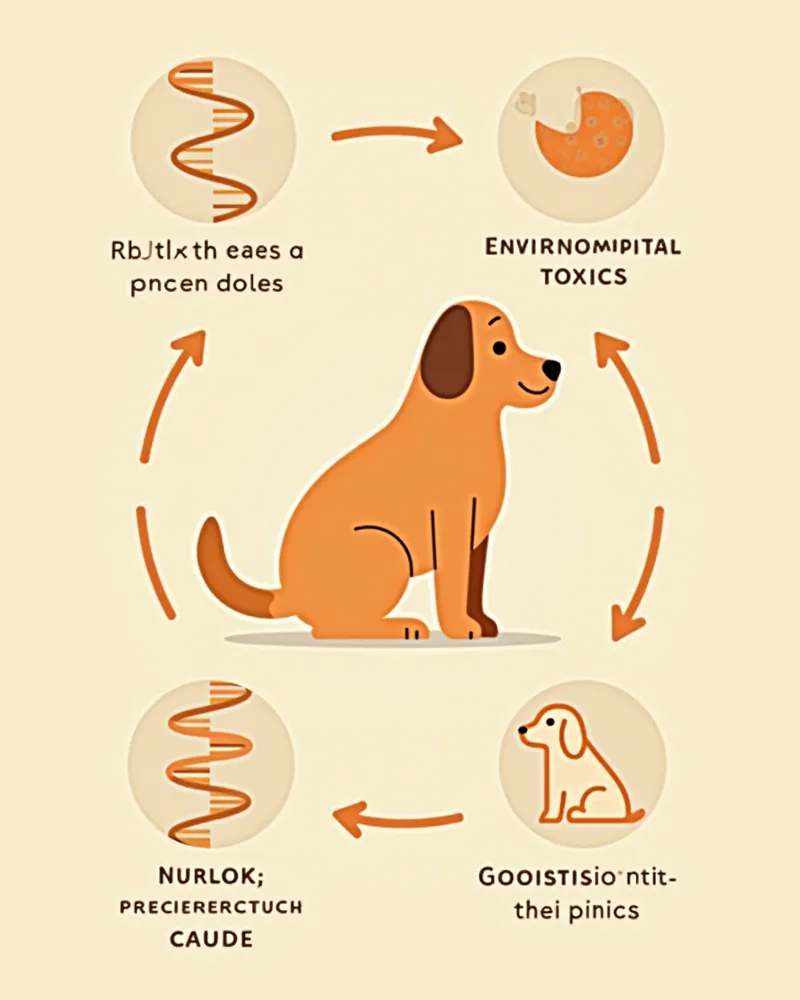
While the exact cause of canine bladder transitional cell carcinoma remains unclear, it is widely believed to result from a complex interplay of genetic predisposition and environmental factors. In fact, specific genetic mutations are identified in approximately 95% of transitional cell carcinoma cases, with the BRAF mutation being particularly prominent as it serves as the target for the commercially available CADET BRAF diagnostic test. Although certain breeds show higher reported incidence rates, it is important to note that findings from breed-specific studies cannot be directly generalized to all dogs. The risk of tumor development tends to increase with age, making this condition more commonly diagnosed in middle-aged and older dogs. While a direct causal link between bladder inflammation or chronic irritation and the disease has not been definitively established, clinical evidence suggests that chronic irritation may influence lesion development. For dogs suspected of having a genetic predisposition, regular veterinary check-ups and consistent health monitoring are essential.
A diagram outlining the main risk factors for bladder cancer in dogs

Main Symptoms and Signs

The most common symptom of bladder transitional cell carcinoma in dogs is hematuria, which refers to blood appearing in the urine. While sometimes visible during urination, it may also be microscopic and only detectable through urinalysis. Other symptoms include frequent urination, difficulty urinating, and pain during urination. If the tumor obstructs the bladder trigone or urethra, it can make urination itself increasingly difficult.
Hematuria: Blood in the urine, the most frequently reported sign.
Frequent urination (pollakiuria): The bladder becomes irritated, causing the dog to urinate small amounts frequently.
Difficulty urinating (dysuria): Straining during urination, with a weak or intermittent urine stream.
Pain during urination (dysuria): Signs of discomfort such as straining or whining while urinating.
Progression of urinary obstruction: As the tumor grows or blocks the urethra, urination becomes progressively more difficult.
An illustration showing a dog experiencing pain during urination and displaying hematuria (blood in the urine).

Symptoms Requiring Immediate Veterinary Visit

If your dog shows blood in the urine or continues to struggle and show signs of pain while urinating, it is essential to visit a veterinary clinic immediately. These lower urinary tract symptoms can also be seen in conditions such as cystitis or urinary stones, so diagnostic tests are necessary to identify the underlying cause. If a tumor is present, early detection is crucial because the condition can progress, potentially leading to invasion of surrounding tissues or metastasis.

Diagnostic Methods

Diagnosing canine bladder transitional cell carcinoma involves a comprehensive approach using multiple tests. First, a urinalysis checks for hematuria (blood in the urine) and abnormal epithelial cells (dysplastic cells), while cytology of the urine sediment evaluates for signs of malignant cells. An abdominal ultrasound helps determine the location, size, and extent of invasion of any masses within the bladder. To confirm the diagnosis, tissue samples are obtained through methods such as catheter-guided aspiration biopsy. Additionally, BRAF testing, which detects a genetic mutation present in approximately 95% of cases, may be used as a supplementary diagnostic tool. Chest radiographs are performed to assess for metastasis. If you suspect your dog is showing symptoms, please visit your veterinarian immediately.
Ultrasound and MRI images showing a tumor in a dog’s bladder

Treatment Methods and Step-by-Step Approach
Treatment for bladder transitional cell carcinoma depends on the tumor’s size, location, and whether it has metastasized. The main treatment options are surgery, radiation therapy, and medication (chemotherapy). Surgery may be considered when the tumor is confined within the bladder, but it must be carefully weighed due to the risk of tumor seeding at the incision site. If metastasis is present or surgery is not feasible, radiation or chemotherapy may be used in combination.
Surgical Treatment: Performed to remove or reduce the size of the tumor, with options including partial resection or debulking surgery.
Radiation Therapy: Used when surgery is not possible or to shrink the lesion.
Chemotherapy: Applied when there is a risk of metastasis or as an adjuvant after surgery, using drugs such as doxorubicin, cyclophosphamide, mitoxantrone, cisplatin, and carboplatin.
Adjunctive Therapy: The nonsteroidal anti-inflammatory drug piroxicam has shown a response rate of approximately 18% when used alone, and about 35% when combined with chemotherapy.
Medical images showing the surgical procedure for bladder cancer in dogs

Home Care and Daily Care Points

Home care is crucial for dogs undergoing cancer treatment. After surgery, rest and pain management are essential, while chemotherapy may cause decreased appetite or vomiting. Encourage water intake and provide frequent bathroom access for proper urine management. Additionally, maintain a quiet environment and consistent daily routine to minimize stress.
Encouraging water intake: Dilutes urine to reduce bladder irritation.
Urine management: Empty the litter box frequently and change pee pads regularly.
Pain management: Administer prescribed pain medication exactly as directed by your veterinarian.
Reducing stress: Maintain a quiet environment and consistent daily routine.
An illustration showing a stable environment for home care of puppies

Preventing Recurrence and Breed-Specific Precautions

Bladder transitional cell carcinoma can invade surrounding tissues and carries a risk of recurrence or metastasis as it progresses, making regular check-ups essential. Although a genetic predisposition has been identified in certain breeds, it is difficult to directly extrapolate breed-specific findings to all dogs, so this information should be taken as a general reference. Dogs in middle age or older, as well as those with symptoms such as hematuria, are advised to undergo regular urinalysis and ultrasound examinations. Routine health screenings are crucial for the early detection of initial lesions.

Reviewed by a veterinarian

Dr. Tony — Punnawat Phongkittirak

Dr. Tony — Punnawat Phongkittirak

Veterinarian

A veterinarian who majored in veterinary medicine at Khon Kaen University, Thailand, and completed the IVSA program at North Carolina State University in the United States. Drawing on clinical experience at animal hospitals, he works in the pet healthcare field and is dedicated to building a digital care environment that connects pet parents with veterinarians.

Frequently Asked Questions

Is canine bladder transitional cell carcinoma curable?
If detected early, surgery or radiation therapy may be used to remove the affected tissue, but a complete cure is usually difficult, so the primary goal of treatment is to extend the pet’s lifespan. In cases where the disease has spread, treatment focuses mainly on prolonging life and managing symptoms.
Does blood in the urine always mean cancer?
Hematuria, or blood in the urine, can be caused by various conditions other than cancer, such as bacterial cystitis and urinary tract stones. However, if it persists, bladder transitional cell carcinoma should be suspected, and diagnostic testing is necessary.
How is a dog’s quality of life after bladder cancer treatment?
With appropriate treatment, pain management, and regular monitoring, many dogs can maintain their daily routines and enjoy a relatively good quality of life. Associated symptoms that arise during treatment can also be effectively managed.
Which dog breeds are at higher risk of developing bladder cancer?
Bladder transitional cell carcinoma is more frequently reported in certain breeds, and genetic predisposition is known to play a role. However, it’s difficult to directly extrapolate breed-specific studies to all dogs, so it’s best to closely monitor middle-aged and older dogs for any symptoms.
Is chemotherapy a heavy burden for dogs?
Chemotherapy can have side effects, but when combined with pain relievers and other supportive treatments, it can usually be administered without significantly compromising your pet’s quality of life. Side effects may vary from individual to individual.

Comparison of Bladder Transitional Cell Carcinoma Treatment Methods

ItemTiming of UseEfficacySide Effects
Surgical TreatmentWhen the tumor is confined within the bladderHighModerate
Radiation TherapyInoperable or suspected metastasisModerateLow
ChemotherapyPossible metastasis or as adjuvant therapy after surgeryModerateModerate

The treatment method is decided by the veterinarian based on the tumor stage and the dog's overall health condition.

Share

Related Guides

References

[1] Rebhun, L. et al. (2013). Veterinary Surgical Oncology, 2nd Edition. Elsevier.

[2] Hahn, K. & McEntee, K. (1997). Feline primary lung tumors: a review. Journal of Feline Medicine and Surgery.

[3] Small Animal Cytologic Diagnosis Canine and Feline Disease, 2nd Edition. (2022). Wiley-Blackwell.

This information is based on veterinary literature and does not replace diagnosis or treatment. Please consult a veterinarian for specific health concerns.

Metapet Co., Ltd. | CEO: Park Sung-yong | Business Reg. No. 417-88-02562 | Seoul, South Korea | Customer Center

Dog Bladder Transitional Cell Carcinoma: Signs & Care | Meongsiljang