Like
Share
멍실장
페르시안 다낭신 주의점과 연령별 평생 건강관리 가이드

Precautions for Polycystic Kidney Disease in Persian Cats and an Age-Specific Lifetime Health Management Guide

KidneyBreed HealthMeongsiljang Veterinary Advisory Board

We’ve outlined the causes, symptoms, and diagnostic methods for polycystic kidney disease (PKD), a genetic condition in Persian cats. Check out age-specific management plans and key checkpoints for pet owners to keep in mind.

What is Polycystic Kidney Disease (PKD) in Persian Cats?

Full-body photo of a Persian cat
Polycystic kidney disease (PKD) in Persian cats is a hereditary, progressive condition in which fluid-filled cysts form within the kidneys and gradually enlarge, impairing kidney function. It is caused by a mutation in the PKD1 gene and can also affect breeds with Persian ancestry, such as Exotic Shorthairs and Himalayans. The most critical point to remember is that most cats show no obvious symptoms until they are 7 to 8 years old. By the time symptoms appear, kidney function is often already significantly compromised, making regular ultrasound screenings essential.

Why is PKD Common in Persian Cats?

Polycystic kidney disease (PKD) is an autosomal dominant genetic disorder. If either parent carries the PKD gene, there is approximately a 50% chance of passing it on to their offspring. The PKD1 gene mutation, which originated in Persian cats, has spread through breeding to other breeds such as Exotic Shorthairs, Himalayans, and Birmans. The most reliable way to prevent this condition is to verify the negative PKD genetic test results of breeding cats before acquiring a kitten. DNA genetic testing for PKD is also available at certain diagnostic centers in Korea.

PKD Symptom Checklist — Signs That Are Easy to Miss

In the early stages, there are typically no noticeable symptoms. The following signs appear as the cysts enlarge and kidney function declines:
Loss of appetite: As toxins build up, your pet may start refusing food.
Weight loss: You may notice sudden thinning or muscle wasting.
Polydipsia and polyuria: Your pet will drink more water than usual and produce larger volumes of urine.
Lethargy and weakness: Activity levels decrease, and your pet may sleep more than usual.
Vomiting and nausea: Gastrointestinal symptoms arise due to uremia.
Abdominal distension: If the cysts are large, the abdomen may feel thickened or swollen.
A veterinarian examining the abdomen of a Persian cat

Symptoms Requiring Immediate Veterinary Attention

If you notice any of the following symptoms, please visit a veterinary clinic within 24 hours, as this may indicate an acute exacerbation of polycystic kidney disease (PKD): • Refusal to eat for more than 24 hours • Vomiting three or more times in a day • Pale or yellowish gums and oral mucosa • Collapse or inability to stand due to weakness • Little to no urination, or a sudden decrease in urine output

Diagnostic Methods — When Should Ultrasound Screening Begin?
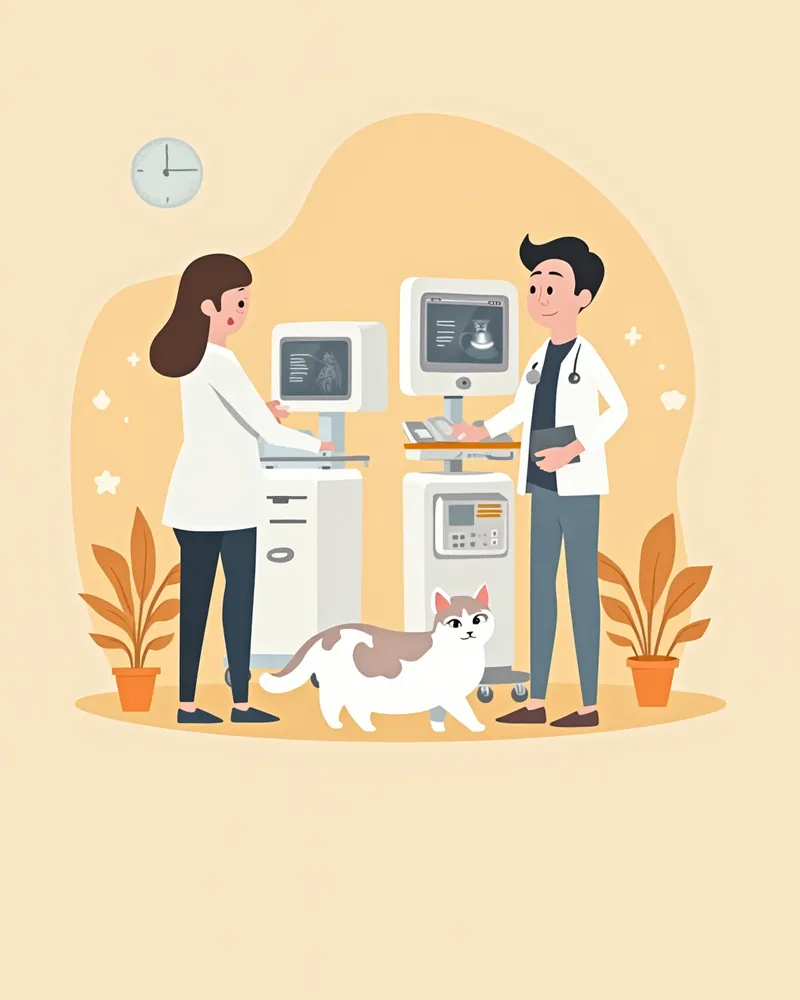
The most reliable method for diagnosing polycystic kidney disease (PKD) is renal ultrasound, which allows direct visualization of cysts within the kidneys. Persian cats often appear normal in their youth, but as they age, their kidneys enlarge and the cysts become more distinct. Therefore, performing an initial ultrasound at a young age and following up with another scan as the cat matures enables clearer visualization and more accurate diagnosis. Blood tests measuring blood urea nitrogen (BUN) and creatinine levels are also conducted; however, these values may remain within the normal range until kidney function has significantly declined. Consequently, it is important to evaluate the ultrasound images comprehensively rather than relying solely on blood test results.
Scene of a Persian cat undergoing a kidney ultrasound examination

Age-Specific Health Management Schedule — Tailored Approaches by Age

Managing polycystic kidney disease (PKD) in Persian cats requires an age-specific approach.
0–6 months: Genetic testing or an initial ultrasound screening is recommended after adoption.
6–12 months: Repeat ultrasound around 9 months of age (cysts become more visible and diagnostic accuracy improves compared to earlier exams) plus basic blood and urine tests.
1–6 years: Annual ultrasound and routine blood and urine tests; maintain this schedule if results are normal.
7 years and older: Since kidney function tends to decline during this stage, shorten the interval to every 6 months and closely monitor kidney values.
If kidney function decline is confirmed: Switch to a renal prescription diet, increase water intake, and begin phosphorus (P) restriction.

Treatment and Long-Term Management — No Cure, But Manageable

The goal in managing polycystic kidney disease (PKD) is not to cure it, but to slow its progression and maintain quality of life. If cysts severely compress surrounding tissues or cause significant pain, fluid drainage may be performed under ultrasound guidance. When kidney function declines, we follow a chronic kidney failure management protocol that includes a renal prescription diet, fluid supplementation, and phosphorus restriction. Feeding wet food and using fountain-style water dispensers can help increase water intake.
A Persian cat drinking water from a fountain-style water dispenser

Additional Information for Persian Cat Owners

Persians may experience respiratory issues and tear duct abnormalities due to their flat facial structure (brachycephaly), which can occur alongside polycystic kidney disease (PKD). If dental procedures or surgeries requiring general anesthesia are necessary for a cat with compromised kidney function, it is essential to check kidney values and conduct a pre-anesthetic evaluation beforehand. For cats diagnosed with PKD, please inform your veterinarian about their kidney condition prior to any procedure or surgery.

Reviewed by a veterinarian

Dr. Tony — Punnawat Phongkittirak

Dr. Tony — Punnawat Phongkittirak

Veterinarian

A veterinarian who majored in veterinary medicine at Khon Kaen University, Thailand, and completed the IVSA program at North Carolina State University in the United States. Drawing on clinical experience at animal hospitals, he works in the pet healthcare field and is dedicated to building a digital care environment that connects pet parents with veterinarians.

Frequently Asked Questions

I just got a Persian cat. Is it really necessary to have it tested for PKD?
Yes, please go ahead and get the test. If you haven’t already confirmed the breeding cat’s PKD test results with the breeder, it’s best to have an ultrasound done around 36 weeks of age (about 9 months). The earlier it’s detected, the sooner we can put a management plan in place.
How long can a pet live after being diagnosed with PKD?
It varies from cat to cat. Many cats live symptom-free until they’re 7 or 8 years old, after which their kidney function gradually declines. With regular check-ups and consistent dietary management, many cats can maintain a good quality of life and live for a long time.
What kind of food should I give to a cat with PKD?
If kidney function is compromised, your veterinarian will likely recommend a prescription renal diet. The key is to reduce protein and phosphorus intake while increasing hydration. If kidney values are still within the normal range, a regular diet may be acceptable, but it’s best to pair it with wet food and ensure adequate water intake.
Can kittens also be tested for PKD?
Yes, it’s possible. Cysts can be detected via ultrasound starting at 16 weeks of age. For more accurate results, we recommend testing after 36 weeks of age. DNA genetic testing can also be performed from an early age.
A cyst was found—does it need to be surgically removed right away?
The presence of a cyst doesn’t automatically mean surgery is required. We only consider drainage procedures if the cyst is severely compressing surrounding tissues or causing significant pain. In most cases, we prioritize regular monitoring and dietary management.

Share

Related Guides

References

[1] Little SE (ed). The Cat: Clinical Medicine and Management, 2nd Edition. Elsevier Saunders, 2012. Section IV Feline Internal Medicine, Chapter 35: Diseases of the Kidney — Polycystic Kidney Disease (PKD1 gene mutation, asymptomatic until 7–8 years, cyst drainage therapy).

[2] Schaer M, Gaschen F (eds). Clinical Medicine of the Dog and Cat, 4th Edition. CRC Press, 2022. Chapter 13: Renal Cystic Disorders — PKD in Persian cats, ultrasound sensitivity 75% at 16 weeks / 91% at 36 weeks, specificity 100%.

[3] Atkinson T. A Professional's Guide to Feline Behaviour: Understanding, Improving and Resolving Problems. CABI, 2018. Chapter 6: Persian breed brachycephalic skull structure and PKD inheritance risk.

This information is based on veterinary literature and does not replace diagnosis or treatment. Please consult a veterinarian for specific health concerns.

Metapet Co., Ltd. | CEO: Park Sung-yong | Business Reg. No. 417-88-02562 | Seoul, South Korea | Customer Center

Persian Cat PKD Guide: Symptoms, Diagnosis & Age Care | Meongsiljang