Like
Share
멍실장
소변검사 결과 읽는 법 — 혈뇨·단백뇨·결정 완전 해석

How to Read Urinalysis Results — A Complete Guide to Hematuria, Proteinuria, and Crystals

UrinaryQ&AMeongsiljang Veterinary Advisory Board

We’ve put together a simple guide to help you understand what hematuria, proteinuria, and crystals mean on your pet’s urinalysis report, along with normal ranges and what to do if the results are abnormal.

How to Read Your Pet’s Urinalysis Report

A scene of a urine test being conducted at an animal hospital.
A pet urinalysis is a basic test that analyzes the components in urine to detect urinary, kidney, and metabolic abnormalities early on. What’s truly important is that pet owners should have a basic understanding of the terms listed on the results sheet so they can accurately follow the veterinarian’s explanations. Hematuria, proteinuria, and crystals are the three most common abnormal findings, each indicating different potential diseases. We’ve provided a simple summary of the normal ranges for each parameter and what steps to take if an abnormal result appears.

5 Key Items on the Urinalysis Report

A urinalysis report includes many items, but we’ve highlighted the key ones pet owners should pay close attention to.
Specific gravity: This indicates how concentrated the urine is and serves as a basic indicator of whether the kidneys are properly concentrating urine.
pH: This measures the acidity or alkalinity of the urine and provides important clues for predicting the type of urinary stones.
Occult blood: This checks for the presence of blood components in the urine. A positive result suggests hematuria (blood in the urine).
Protein: Normally, protein should be barely detectable. Its presence may be an early sign of kidney damage.
Crystals: This checks for crystals in the urine. However, the presence of crystals does not always indicate an abnormality. Crystals can form due to urine concentration, pH, and temperature, and their presence does not necessarily mean stones are present. Therefore, we assess the risk of stone formation when crystals are repeatedly found in large amounts.

Normal Reference Ranges for Dog and Cat Urinalysis

The table below shows the normal reference ranges for key urine test parameters in dogs and cats. Note that normal values can vary by species, so be sure to check the appropriate column. The specific gravity range for cats is based on a dry food diet; if your cat primarily eats wet food, the normal range may differ.
ParameterNormal Range for DogsNormal Range for Cats
Specific Gravity1.015–1.0501.035–1.070
pH5.5–7.55.5–7.5
Occult BloodNegativeNegative
ProteinNegative to TraceNegative to Trace
GlucoseNegativeNegative
CrystalsNoneNone

Hematuria — When Blood Appears in the Urine
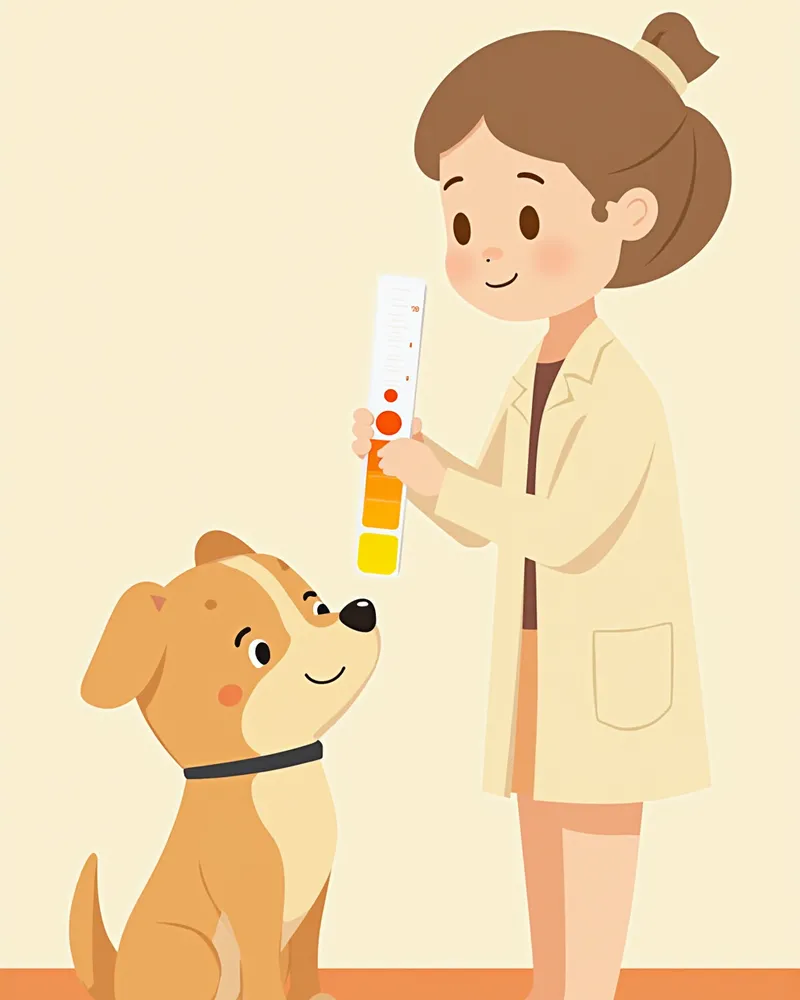
Hematuria refers to the presence of blood in the urine. If a urinalysis strip tests positive for occult blood, hematuria is suspected.
Cystitis and urinary tract infections: Bacterial infections can cause inflammation of the bladder wall, leading to bleeding. This is one of the major causes of hematuria in dogs.
Urinary tract stones: Stones in the bladder or urethra can irritate the mucous membranes, resulting in blood-tinged urine.
Feline idiopathic cystitis: In cats, bladder inflammation often occurs without bacterial infection, frequently triggered by stress. Feline idiopathic cystitis, where a specific cause cannot be identified, is known as a significant cause of hematuria in cats.
Tumors and trauma: Although rare, bleeding can also result from bladder tumors or physical trauma.
A veterinarian examining a urine test strip.

Seek Veterinary Care Immediately for These Symptoms

If your cat’s urine is a deep red or contains blood clots, seek veterinary care immediately. This is especially critical for male cats who are unable to urinate and show signs of vomiting or lethargy, as this may indicate a life-threatening urethral obstruction. The longer urination is blocked, the higher the risk of severe complications such as kidney damage and hyperkalemia, so prompt emergency treatment is essential.

Proteinuria — An Early Warning Sign from the Kidneys

Proteinuria is a condition in which an abnormal amount of protein leaks into the urine. Normally, the kidneys filter blood and retain protein within the body, but when this function is impaired, protein escapes into the urine.
Early sign of kidney disease: Proteinuria is one of the earliest indicators of kidney damage. It can appear even when blood tests show normal kidney values.
Urine protein-to-creatinine ratio: Veterinarians use this ratio to assess the severity of proteinuria. A higher value indicates that more protein is leaking from the kidneys.
Regular monitoring of this ratio is recommended for senior pets and certain breeds.
A dog waiting patiently while the veterinarian reviews the test results.

Crystals and Stones — Mineral Clumps in the Urine

Crystals in the urine form when minerals clump together into a visible shape. If left unchecked, they can grow into stones, making early intervention essential.
Struvite crystals: In dogs, these often develop alongside urinary tract infections, while in cats, they can appear even without an infection. They can frequently be dissolved through dietary management and treatment of any underlying infection.
Calcium oxalate crystals: These cannot be dissolved with diet, so if they grow into large stones, surgical removal is necessary. Because the recurrence rate is high, a preventive diet is crucial.
Urate crystals: These are most commonly seen in Dalmatians or pets with liver disease.
The type of crystal that forms depends on urine acidity, so managing pH levels is the key to prevention.

Urine Collection Methods and Testing Frequency for Accurate Results

The collection method is crucial for accurate urinalysis results.
Cystocentesis: A veterinarian uses a fine needle to collect urine directly from the bladder. This method yields the most accurate results by preventing bacterial contamination.
Free-catch urine: You can collect the sample at home. It is best to catch midstream urine in a clean container and bring it to the clinic within two hours.
Testing frequency: Healthy adult dogs and cats should have this test included in their annual wellness exam. For pets aged seven years or older, or those with a history of kidney or urinary tract disease, we recommend testing every six months. Please consult your veterinarian to determine the appropriate schedule for your pet.
A pet owner collecting a urine sample from their dog

Risk of Urinary Tract Diseases Varies by Breed

Certain breeds are at higher risk for urinary tract diseases, so it’s a good idea to have their urine tested more frequently. Dalmatians and English Bulldogs are prone to urate stones, Miniature Schnauzers to calcium oxalate stones, and Persian cats to polycystic kidney disease. Owners of these breeds should consult their veterinarian to establish a regular screening schedule.

Reviewed by a veterinarian

Dr. Tony — Punnawat Phongkittirak

Dr. Tony — Punnawat Phongkittirak

Veterinarian

A veterinarian who majored in veterinary medicine at Khon Kaen University, Thailand, and completed the IVSA program at North Carolina State University in the United States. Drawing on clinical experience at animal hospitals, he works in the pet healthcare field and is dedicated to building a digital care environment that connects pet parents with veterinarians.

Frequently Asked Questions

Can a disease be definitively diagnosed with a urine test alone?
Urinalysis is a screening test. If any abnormalities are detected, further tests such as blood work, ultrasound, or X-rays will be performed to establish an accurate diagnosis. If the urinalysis reveals any issues, your veterinarian will guide you through the next steps in the diagnostic process.
Are there any precautions to keep in mind when collecting urine at home?
Collect a midstream urine sample in a clean container and bring it to the clinic within two hours. Delays can allow bacteria to multiply or new crystals to form, compromising test accuracy. Prompt submission is more important than refrigeration.
Is it a problem if the urine is a deep yellow color?
Drinking too little water can concentrate the urine, making it a darker yellow. If this is only temporary, there’s usually no need to worry. However, if it persists or the urine appears brownish, it could indicate dehydration or liver or kidney issues, so it’s best to have your pet checked by a veterinarian.
The diagnosis has been made, but if there are no symptoms, is treatment still necessary?
The presence of crystals doesn’t always indicate a problem. Crystal formation can be influenced by urine concentration, pH, and temperature, and finding crystals doesn’t necessarily mean your pet has developed stones. However, if crystals are repeatedly detected, managing water intake and adjusting diet can help reduce the risk of stone formation. It’s a good idea to consult with your veterinarian to create a monitoring and prevention plan.
How much does a urinalysis cost?
While costs vary by clinic, a standard urine dipstick test typically ranges from $10 to $20. Additional tests, such as bacterial culture or urine protein-to-creatinine ratio analysis, may incur extra charges. For an exact quote, please contact the clinic before your visit.

Share

Related Guides

References

[1] Schaer M. Clinical Medicine of the Dog and Cat, 4th Ed. CRC Press, 2022

[2] Englar R.E. The Veterinary Workbook of Small Animal Clinical Cases. 5m Publishing, 2023

[3] Sink C.A., Weinstein N.M. Practical Veterinary Urinalysis. Wiley-Blackwell, 2012

This information is based on veterinary literature and does not replace diagnosis or treatment. Please consult a veterinarian for specific health concerns.

Metapet Co., Ltd. | CEO: Park Sung-yong | Business Reg. No. 417-88-02562 | Seoul, South Korea | Customer Center

How to Read Pet Urinalysis: Blood, Protein & Crystals | Meongsiljang