Like
Share
멍실장
고양이 할큄병(바르토넬라) 완벽 가이드

The Complete Guide to Cat Scratch Disease (Bartonella)

Skin & CoatDiseasesMeongsiljang Veterinary Advisory Board

Cat scratch disease is a zoonotic infection caused by Bartonella bacteria. While cats are typically asymptomatic carriers, the disease can be transmitted to humans and dogs. Here’s a summary of the symptoms, treatment, and prevention.

What is Cat Scratch Disease?

An illustration of a cat that looks healthy but may carry Bartonella bacteria.
Cat Scratch Disease is a zoonotic infection caused by the bacterium Bartonella henselae. The most important thing to know is that most cats are asymptomatic carriers. Even if they appear perfectly healthy, they can carry the bacteria, which can be transmitted to humans and other pets through scratches, bites, or fleas. In children, the elderly, and immunocompromised individuals, the infection can lead to lymphadenitis and fever, making preventive care by pet owners essential.

Causes and Transmission Routes

The primary vector for cat scratch disease is the cat flea (Ctenocephalides felis). Among cats, the bacteria are mainly transmitted through flea bites, and transmission via predation on infected prey, such as rodents, has also been reported. Once a cat becomes a carrier, the bacteria can enter the body of humans or other animals through wounds caused by scratches or bites. Consequently, outdoor cats, cats without flea prevention, and multi-cat households have significantly higher infection rates. In humans, transmission has also been reported through flea and tick bites, as well as through contact of cat saliva with broken skin.

Key Symptoms Checklist

While cats are mostly asymptomatic, people and dogs can develop the following symptoms.
Cats: Most cats show no symptoms. Rarely, mild symptoms such as fever and lethargy lasting 2–3 days, which typically resolve on their own, or lymph node swelling may appear.
Dogs: Endocarditis, uveitis, and discospondylitis (inflammation of the spine and intervertebral discs) have been reported. Male dogs may develop epididymitis, orchitis, or scrotal dermatitis, while female dogs may experience miscarriage or other reproductive-related symptoms.
Humans: A red papule may appear at the scratch site. After an incubation period of several weeks to 1–2 months, symptoms such as swelling of the axillary or cervical lymph nodes, low-grade fever, and fatigue may develop.
High-risk groups: Immunocompromised individuals may progress to liver and spleen involvement (peliosis hepatis), bacillary angiomatosis, endocarditis, or polyarthritis.
If symptoms appear, be sure to inform your doctor or veterinarian that you have been scratched by a cat, as this is essential for an accurate diagnosis.
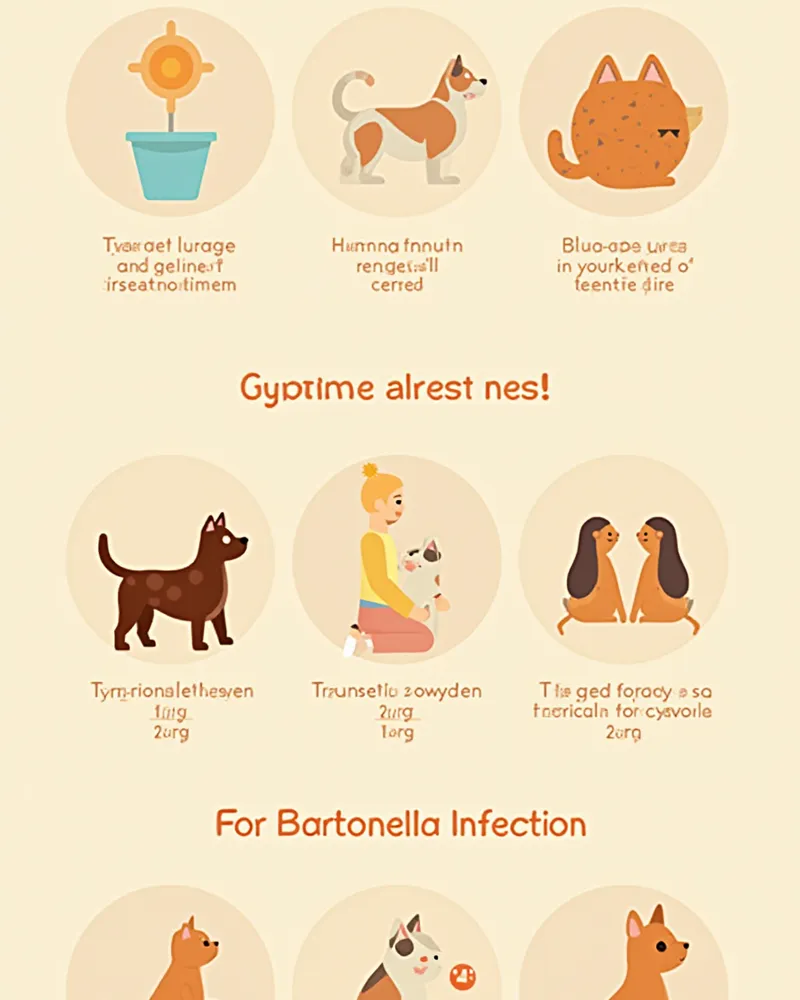
Illustration comparing Bartonella symptoms in cats, dogs, and humans

When to Seek Immediate Veterinary Care

If the scratch site becomes red and swollen with pus, or if the lymph nodes in the armpits, neck, or groin become firm and swollen over time (usually within a few weeks to 1–2 months), suspect cat scratch disease. Seek immediate care at an internal medicine or infectious disease clinic if high fever persists or is accompanied by headache, fatigue, or muscle pain. Never ignore even minor symptoms if you are taking immunosuppressants or undergoing cancer treatment, as immunocompromised individuals are at risk of progressing to severe conditions such as bacterial endocarditis or bacillary angiomatosis. If your dog suddenly shows weakness or difficulty breathing, endocarditis may be suspected, requiring prompt veterinary evaluation.

Diagnostic Methods

Cat scratch disease diagnosis begins with a thorough medical history, particularly regarding contact with cats. We confirm antibodies against Bartonella through serological testing (IFA) and can directly detect bacterial DNA in blood and lymph node tissues using PCR. In human cases, swollen lymph nodes are evaluated via ultrasound, with biopsies performed if necessary. However, a positive antibody test does not necessarily indicate an active infection. As outlined in veterinary internal medicine textbooks, the standard approach is to make a diagnosis by integrating clinical symptoms with test results.

Treatment Options

Mild infections in healthy people and animals often resolve on their own. However, if lymph nodes swell significantly or fever persists, antibiotic treatment is necessary. In humans, azithromycin and doxycycline are commonly used. For animals, veterinarians determine the appropriate antibiotic type and duration (typically 4–6 weeks) based on weight, symptoms, and liver function values. Severe complications such as endocarditis may require hospitalization. Never administer human antibiotics to animals based on self-diagnosis.
A veterinarian examining a cat's lymph nodes

Home Care and Prevention Tips

The key to prevention is blocking fleas. Please consistently follow these steps:
Monthly flea prevention medication: Apply to all pets equally.
Nail care: Trim the tips every 2–3 weeks.
Immediate wound cleansing: Wash scratches immediately with running water and soap for at least 5 minutes.
Avoid kissing and licking: Especially on the face and any wounds.
Cleaning for multi-cat households: Wash bedding and rugs at high temperatures once a week.
Isolate immunocompromised individuals: Those undergoing chemotherapy or organ transplants should carefully consider adopting kittens.
For newly adopted stray cats, it is safest to quarantine them for a month before introducing them to other pets.

High-Risk Groups to Watch Out For

Pregnant individuals, children under five, adults over 65, and caregivers undergoing chemotherapy or taking immunosuppressants are at higher risk of severe complications from Bartonella infection, such as bacillary angiomatosis, endocarditis, and polyarthritis. Since kittens are more prone to biting and scratching, which increases exposure risk, please carefully consider adoption and ensure rigorous flea prevention if you do bring one home. Avoid rough play involving hands and feet with your cat, and always wear gloves if you have any cuts or wounds on your hands.

Reviewed by a veterinarian

Dr. Tony — Punnawat Phongkittirak

Dr. Tony — Punnawat Phongkittirak

Veterinarian

A veterinarian who majored in veterinary medicine at Khon Kaen University, Thailand, and completed the IVSA program at North Carolina State University in the United States. Drawing on clinical experience at animal hospitals, he works in the pet healthcare field and is dedicated to building a digital care environment that connects pet parents with veterinarians.

Frequently Asked Questions

Should I still get my cat tested even if it shows no symptoms?
If you live with someone who has a weakened immune system or have recently adopted a kitten, we recommend getting PCR and antibody tests at least once. For most households, keeping up with flea prevention is more important than regular testing.
Is it okay to disinfect with alcohol right after applying Halquin?
Washing with running water and soap for at least five minutes is the most effective approach. Alcohol only disinfects the surface and has limited efficacy for deep wounds. If the wound is deep or bleeding heavily, it's safest to have it examined at a veterinary clinic.
Can dogs get cat scratch disease?
Yes, dogs can also become infected with Bartonella. However, the species involved are slightly different (such as B. vinsonii subsp. berkhoffii), and the infection often manifests as endocarditis or uveitis, leading to a wide variety of symptoms.
Is it 100% safe if I just use flea prevention medication properly?
Flea prevention is the most important barrier, but it’s not 100% foolproof. Outdoor activities, multi-cat households, and tick exposure can all affect the situation. It’s safest to also take care of nail trimming and wound hygiene.
Does recovering from cat scratch disease provide immunity?
In humans, the development and duration of immunity vary greatly from person to person, so it is difficult to make definitive conclusions based solely on textbook evidence. Since bacteremia can occur intermittently and there is the possibility of exposure to other bacterial species, basic preventive measures such as flea control and wound hygiene remain necessary even after a previous infection.

Share

Related Guides

References

[1] Greene CE, Infectious Diseases of the Dog and Cat, 4th Edition, Chapter Bartonellosis, 2012

[2] August JR, Consultations in Feline Internal Medicine, Volume 7, Bartonella Infections in Cats, 2016

[3] Chomel BB et al., Bartonella spp. in pets and effect on human health, Emerging Infectious Diseases, 2006

[4] Breitschwerdt EB, Bartonellosis: One Health perspectives for an emerging infectious disease, ILAR Journal, 2014

This information is based on veterinary literature and does not replace diagnosis or treatment. Please consult a veterinarian for specific health concerns.

Metapet Co., Ltd. | CEO: Park Sung-yong | Business Reg. No. 417-88-02562 | Seoul, South Korea | Customer Center

Cat Scratch Disease (Bartonella): Symptoms, Treatment & Prevention | Meongsiljang