Like
Share
멍실장
고양이 심인성 탈모 고양이 증상과 원인, 진단·치료와 관리 포인트 총정리

Why Is My Cat Licking Its Hair Out? — Causes and Treatment Timing for Psychogenic Alopecia

Brain & CognitionDiseasesMeongsiljang Veterinary Advisory Board

Psychogenic alopecia in cats is a behavioral disorder where stress or anxiety leads to excessive grooming and hair loss. I’ve compiled a comprehensive guide based on veterinary resources, covering everything from identifying the cause to treatment and home care.

What Is Feline Psychogenic Alopecia?

Cats that excessively groom their bellies
Feline psychogenic alopecia is a behavioral disorder in which cats excessively groom themselves—often by over-licking—due to psychological factors such as stress or anxiety, leading to hair loss in the absence of underlying physical disease. The most critical step is to first rule out medical causes. Psychogenic alopecia is a diagnosis of exclusion, meaning it can only be confirmed after all physical causes, including skin parasites, allergies, and endocrine disorders, have been thoroughly investigated and excluded. In fact, studies of cases suspected to be psychogenic alopecia have reported that a significant number also had underlying medical causes such as allergies, parasitic infections, or food-related reactions. Therefore, just as important as identifying stressors is conducting thorough veterinary examinations to carefully check for physical health issues. Only once physical causes have been adequately addressed can behavioral management strategies be truly effective.

Main Causes of Psychogenic Alopecia

Psychogenic alopecia occurs when cats cope with overwhelming stress through excessive grooming.
New pets or family members: Cats with strong territorial instincts can be highly sensitive to new additions.
Moving or environmental changes: A new home or rearranged furniture can also be significant stressors.
Prolonged absence of the owner: This is common in cats with severe separation anxiety.
Persistent noise or vibration: Repeated construction noise or loud sounds can lead to chronic stress.
Once this behavior becomes habitual, excessive grooming may continue even after the original stressor has been removed.

Symptom Checklist — Suspect It If You See These Signs

Check the following signs:
Areas prone to hair loss: Hair loss often occurs in areas that are easy for cats to lick, such as the chest, lower abdomen, inner thighs, flanks, and front legs. The pattern may be symmetrical on both sides, but it can also be asymmetrical, favoring one side.
Hair breakage pattern: The hair isn't lost from the root; instead, it appears broken off from licking. Under a microscope, the hair shafts show blunt, fractured ends rather than tapering to a fine point.
Skin condition: Initially, the skin often looks relatively clean without redness or scabs. However, if excessive grooming continues, it can lead to abrasions, scabs, ulcers, or secondary bacterial infections.
Worsening when the owner is absent: Grooming behavior may increase when the cat is left alone.
Aggravation after specific events: Hair loss may become noticeably more severe after events such as guests visiting or moving to a new home.
However, these signs alone are not enough to definitively diagnose a psychogenic cause. Since the symptoms can resemble those of allergies or parasitic infestations, please consult a veterinarian if you notice any of these signs.
Psychogenic alopecia in cats — symmetrical hair loss on the belly with clean skin

See a Vet Immediately If You Notice These Symptoms

If hair loss is accompanied by redness, oozing, scabs, or a foul odor, it is highly likely to be a skin condition such as bacterial pyoderma (folliculitis) or allergies. If itching or hair loss extends to the face, front paws, and neck area, you should first investigate causes like dermatophytosis (ringworm), demodicosis (mites), or allergies. In older cats, endocrine disorders such as hyperthyroidism must also be ruled out. Psychogenic alopecia can only be diagnosed after all these physical causes have been completely excluded.

Diagnosis — The Key Is the Process of Exclusion

Psychogenic alopecia is a diagnosis of exclusion. We systematically rule out physical causes in the following order: 1. Microscopic hair examination (trichogram): We examine shed hairs under a microscope to distinguish between self-inflicted alopecia from licking and chewing versus spontaneous hair loss. This is the fundamental test recommended first for any type of alopecia. 2. Skin examination: We perform skin scrapings and fungal cultures to rule out parasitic or fungal infections. 3. Allergy assessment: We check for food or environmental allergies. Cats often present with very similar symptoms for allergies, parasites, and dietary reactions, so careful differential diagnosis is essential. 4. Blood and endocrine testing: Especially in older cats, we check for endocrine abnormalities, such as thyroid hormone imbalances. 5. Biopsy: If necessary, we perform a tissue biopsy to check for follicular abnormalities. 6. Behavioral history interview: We identify the onset time, changes in the living environment, and any stressful events. Once all medical tests return normal results, we make the final diagnosis through a behavioral assessment.

Treatment — A Step-by-Step Approach

Treating psychogenic alopecia centers on first addressing any underlying physical causes, then combining environmental enrichment with behavioral modification.
Step 1 — Eliminate stressors: Reduce anxiety by isolating new animals, adding hiding spots, and ensuring safe pathways.
Step 2 — Enrich the environment: Encourage natural hunting and exploration behaviors with cat trees, window hammocks, and food puzzles.
Step 3 — Pheromone support: Use a veterinarian-recommended pheromone diffuser to promote a sense of calm.
Step 4 — Medication: If symptoms persist or are severe despite these measures, a veterinarian may prescribe anti-anxiety medication.
Excessive grooming can become a self-reinforcing habit (compulsion) because the act itself provides calming relief. Therefore, consistent management is essential even after the root cause is addressed. While some pets respond well to environmental changes, the rate of improvement varies from individual to individual.
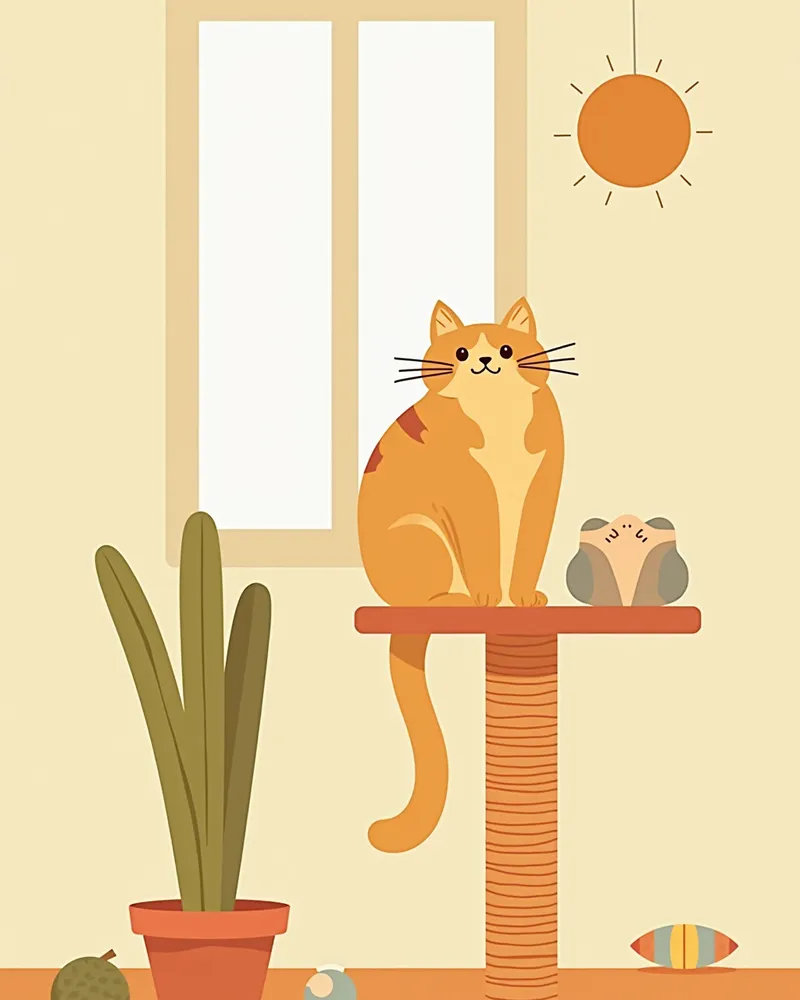
A relaxed cat gazing out the window from a cat tree — an example of environmental enrichment

Home Care Tips — Preventing Recurrence Is Key

Consistent daily care after treatment can help prevent recurrence.
Maintain a consistent routine: Keep feeding and playtimes roughly the same each day.
15 minutes of daily hunting play: Regularly engage your cat with toys that stimulate their hunting instincts, such as wand toys.
Provide a safe retreat: Create a dedicated, quiet space for your cat where they can escape external stimuli.
Monitor around events: Keep an eye on grooming frequency before and after stressful events like guests visiting or moving.
Keep a symptom log: Recording flare-ups will be helpful for your next veterinary consultation.
A cat resting in a safe hiding spot — a stress-relief space

Sensitive Breeds Require Closer Attention

Cats with sensitive temperaments or those prone to stress often respond to environmental changes with excessive grooming. When life changes occur, such as moving, adding a new family member, or increased noise, please monitor their grooming habits more frequently than usual. However, there is limited evidence to definitively claim that certain breeds are more susceptible to psychogenic alopecia. Additionally, since external parasites and dermatophytosis are more common causes of hair loss in young cats, it is safest to rule out physical health issues first, regardless of the cat’s age.

Reviewed by a veterinarian

Dr. Tony — Punnawat Phongkittirak

Dr. Tony — Punnawat Phongkittirak

Veterinarian

A veterinarian who majored in veterinary medicine at Khon Kaen University, Thailand, and completed the IVSA program at North Carolina State University in the United States. Drawing on clinical experience at animal hospitals, he works in the pet healthcare field and is dedicated to building a digital care environment that connects pet parents with veterinarians.

Frequently Asked Questions

Can psychogenic alopecia be completely cured?
Identifying the stressors and improving the environment, along with treating any underlying physical conditions, often leads to improvement over time. However, if the triggers recur, the condition may relapse, and since recovery times vary from pet to pet, consistent care is essential.
Is it absolutely necessary to use an anti-anxiety medication?
In some cases, simply improving the environment and implementing behavioral modifications can lead to improvement. Medication is used at the veterinarian’s discretion when these corrective measures are ineffective or when symptoms are severe. It is best to determine whether medication is truly necessary through a veterinary consultation.
Will the hair in the bald patches grow back?
If excessive grooming stops and the hair follicles remain undamaged, the fur will often grow back over time. However, areas that have developed ulcers or scars due to self-trauma may take longer to heal or may not regrow fur at all.
How can you tell the difference between allergic hair loss and other types of hair loss?
Allergies often present with redness, itching, and scabs, but in cats, the symptoms of allergies, parasitic infestations, and psychogenic causes are very similar, making it difficult to distinguish them based on appearance alone. In fact, reports indicate that many cases suspected to be psychogenic also had underlying medical causes such as allergies or parasites, so an accurate differential diagnosis requires a veterinary examination.
Does it get worse when they’re left alone for long periods?
If separation anxiety is the cause, that could be the reason. Try compensating for the time spent alone by providing plenty of playtime before you leave, using an automatic feeder, and playing background music.

Share

Related Guides

References

[1] Hill P., Chapter 33: The dog that is losing hair, 100 Top Consultations in Small Animal General Practice, Elsevier, 2012

[2] Noli C. et al., BSAVA Manual of Canine and Feline Dermatology, 4th Ed, British Small Animal Veterinary Association, 2020

[3] Overall K.L., Clinical Behavioral Medicine for Small Animals, Mosby, 1997

[4] Waisglass S.E. et al., Underlying medical conditions in cats with presumptive psychogenic alopecia, Journal of the American Veterinary Medical Association, 2006

This information is based on veterinary literature and does not replace diagnosis or treatment. Please consult a veterinarian for specific health concerns.

Metapet Co., Ltd. | CEO: Park Sung-yong | Business Reg. No. 417-88-02562 | Seoul, South Korea | Customer Center

Why Is My Cat Licking Its Hair Out? Psychogenic Alopecia | Meongsiljang