Like
Share
멍실장
신생 자묘(0-2주) 케어 완벽 가이드

The Ultimate Guide to Caring for Neonatal Kittens (0–2 Weeks)

ImmunityQ&AMeongsiljang Veterinary Advisory Board

We’ve put together a clear overview of the key aspects of temperature, feeding, and elimination care for newborn kittens aged 0 to 2 weeks. This guide highlights essential points to keep in mind when raising kittens without their mother.

What Are Neonatal Kittens? The Essentials of 0–2 Week Care

A newborn kitten sleeping in a blanket nest
Neonatal kittens are those aged 0 to 2 weeks old. Because their ability to regulate body temperature and their immune systems are not yet fully developed, this period requires intensive, around-the-clock care. The three key aspects of management are maintaining warmth, feeding, and stimulating elimination. During this stage, kittens cannot maintain their own body temperature or urinate and defecate on their own. If the mother is absent, the caregiver must take on these roles, and any subtle changes in the kitten’s condition should prompt an immediate visit to the veterinary clinic.

Why Is the 0–2 Week Period the Most Dangerous?

Newborn kittens are born with immature abilities to regulate their body temperature, maintain blood sugar levels, and fight off infections. According to veterinary internal medicine textbooks, kittens under two weeks of age have little to no shivering reflex, meaning they cannot generate their own body heat and are at risk of rapid hypoglycemia and dehydration. Their immune systems rely almost entirely on maternal transfer antibodies received from their mother’s colostrum, making those who miss out on colostrum highly vulnerable to infections. Therefore, care during this critical period is essentially about ensuring survival.

Weekly Development & Care Checklist

Item0–3 days4–7 days8–14 days
Average body weight90–110 g120–180 g200–300 g
Eyes·earsCompletely closedMostly closed (some may open early)Eyes open around day 10 (range 2–16 days)
Body temperature (rectal)35.0–37.2℃36.1–37.7℃37.2–38.3℃
Feeding intervalEvery 2 hoursEvery 2–3 hoursEvery 3–4 hours
Elimination stimulationEssential after every feedingEssential after every feedingEssential after every feeding

Body weight and body temperature are the most important indicators of a newborn kitten's health. Weight should increase steadily every day to be normal; failing to gain or even losing weight is a danger sign.

How to Feed Properly
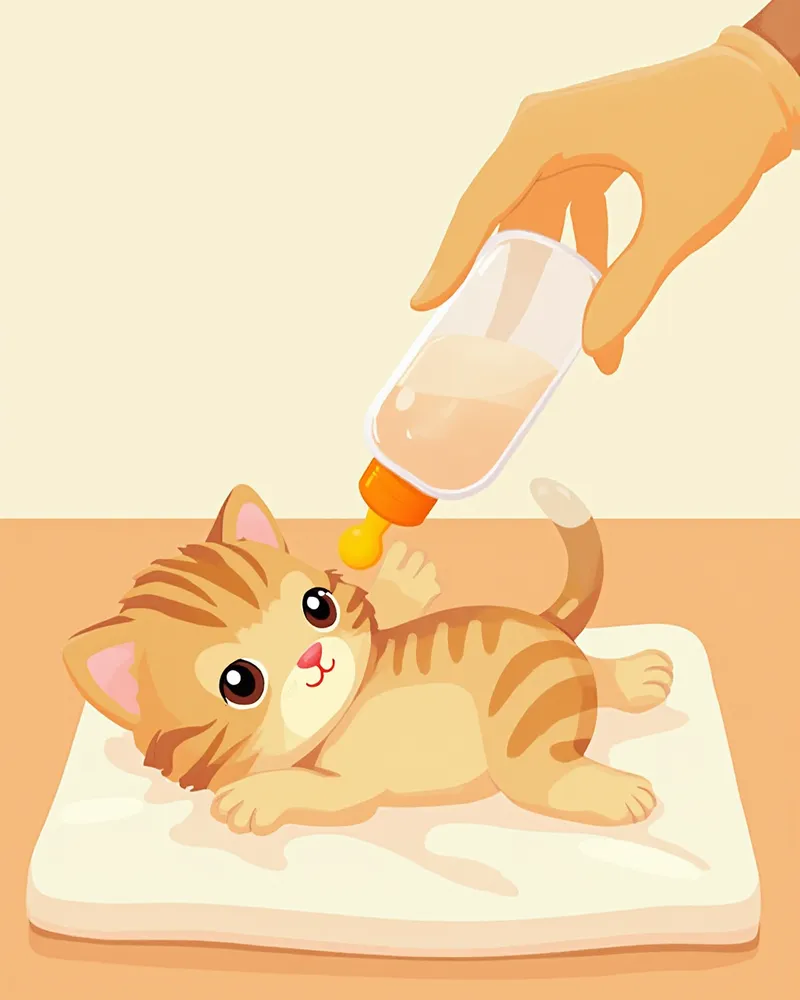
Newborn kittens must be fed kitten-specific formula (such as KMR). Cow’s milk is strictly prohibited because its nutritional composition differs significantly from queen’s milk, which can cause diarrhea and dehydration. Homemade formulas are also prone to errors, so commercially available kitten formulas are the safest choice. - Feeding posture: Place the kitten in a prone position with its belly facing downward. Never feed them lying on their back like human infants, as this greatly increases the risk of milk entering the airway and causing aspiration pneumonia. - Temperature: Warm the formula to approximately body temperature; never feed it cold. - Method: Kittens with a strong suckling reflex should be bottle-fed until they are full. If the suckling reflex weakens, consider it a sign of deteriorating health and seek veterinary care immediately. - Volume caution: Newborn kittens are prone to fluid overload, so avoid overfeeding in a single session. Monitor daily weight gain to ensure they are receiving an adequate amount. - Hypothermia: Never attempt to feed a kitten with a cold body. Prioritize warming the kitten first before attempting any feeding.
Newborn kittens being bottle-fed with formula

Emergency Signs Requiring Immediate Veterinary Attention

If you notice any of the following signs, take your pet to a 24-hour veterinary clinic immediately: - Body temperature drops below 35°C, or feels ice-cold to the touch - Refuses to nurse for more than 12 hours, or lacks the strength to suckle from a bottle - No urine or feces output for 24 hours - Continuous crying and trembling, or conversely, extreme lethargy with no response - Repeated diarrhea or vomiting, accompanied by pale or purplish gums Because neonatal kittens can deteriorate very rapidly, never adopt a "wait-and-see" approach.

Thermoregulation: The Most Critical Survival Management

Newborn kittens cannot regulate their own body temperature. They have a limited ability to generate heat through shivering and, due to their large surface area relative to body size, are highly susceptible to hypothermia. This can lead to suppressed breathing, halted digestion (intestinal motility), and a compromised immune system. - Ambient Temperature: Maintain the nesting area at 27–32°C. Start at the higher end (approximately 29–32°C) during the first week, then gradually lower the temperature as they grow. - Heat Source: Place a pet-safe heating pad on only half of the box, allowing kittens to move away from the heat if they become too warm. - Prohibited: Do not use electric blankets directly, and avoid direct contact with hot water bottles due to the risk of low-temperature burns. - Monitoring: If kittens are sleeping spread apart, they are too warm. If they are huddled tightly together, they are too cold. - Rewarming: Warm chilled kittens slowly over 2–3 hours, ensuring their rectal temperature does not exceed 38.3°C.
Newborn kittens snuggling together on a heating pad

Stimulating Elimination & Hygiene Care

Kittens cannot urinate or defecate on their own until they are 2 to 3 weeks old. Their mother normally licks their perineum to stimulate elimination, so if the mother is absent, the owner must perform this task. - Method: Gently tap the area around the anus and urethra with soft gauze or cotton moistened with warm water. - Timing: Immediately after every feeding, for 20–30 seconds. - Normal elimination: Urination should occur after every feeding; defecation should occur 1–2 times per day. - Precautions: Avoid the area around the umbilicus until it has dried (3–5 days after birth). After stimulation, remove any moisture with a soft towel. Skipping elimination stimulation can cause the bladder to become overfilled, leading to an emergency.

Immunity and Vaccination Preparation

Newborn kittens rely heavily on the immunity they receive from their mother’s milk, especially colostrum, right after birth. However, because their immune systems are still immature, the first two weeks of life and the weaning period are the most critical times for disease and mortality risks. The exact timing for vaccinations and deworming varies depending on the kitten’s age and health status, so it’s best to consult with your veterinarian to create a personalized plan. - 0–2 weeks: Most vaccinations and dewormers are not recommended. Focus on weight management and preventing infections. - Owner hygiene: Always wash your hands and change out of outdoor clothes before handling the kitten. - Separation from other animals: Keep kittens separate from adult cats and dogs until they’ve completed their vaccinations. - First vet visit: Schedule a health checkup around 2–3 weeks of age and discuss the timing of the first deworming. If you’re wondering when your kitten should have its first health checkup, you can also refer to our Kitten Vaccination Schedule Guide.

Reviewed by a veterinarian

Dr. Tony — Punnawat Phongkittirak

Dr. Tony — Punnawat Phongkittirak

Veterinarian

A veterinarian who majored in veterinary medicine at Khon Kaen University, Thailand, and completed the IVSA program at North Carolina State University in the United States. Drawing on clinical experience at animal hospitals, he works in the pet healthcare field and is dedicated to building a digital care environment that connects pet parents with veterinarians.

Frequently Asked Questions

Can I give milk to a newborn kitten?
No, cow’s milk is not suitable for kittens because its nutritional composition differs significantly from that of cat’s milk, which can lead to severe diarrhea and dehydration. Homemade milk replacers are also prone to errors in formulation, so it’s essential to use only kitten-specific milk replacers (such as KMR).
My pet's weight has stayed the same all day. Is that okay?
If your kitten’s weight hasn’t increased over 24 hours—or has actually decreased—you should take them to the vet immediately. Weight and body temperature are the most important indicators of a newborn kitten’s health, so a lack of consistent weight gain or stagnation can be an early sign of hypoglycemia or infection.
Can I give my pet a bath?
Newborn kittens should generally not be bathed, as they are at high risk of rapid body temperature drops. Instead, gently wipe any soiled areas with a warm, damp cloth, dry them immediately, and keep them warm.
If I only have one pet with no siblings, will it feel lonely?
If a single kitten was rescued, maintaining its body temperature is especially important. Place a soft stuffed toy or towel nearby and use a heating pad to keep the nesting area warm. However, to prevent infection, avoid contact with adult cats until the kitten has received its vaccinations.
When can I start potty training my pet?
Puppies typically begin to eliminate on their own around three weeks of age, and by six weeks they can fully control their bowel and bladder movements. At this stage, you can gently train them by placing a small litter box with low sides near their nesting area and lifting them slightly into it after feeding.

Share

Related Guides

References

[1] Little, S.E., The Cat: Clinical Medicine and Management, 2nd Edition, Elsevier, 2024

[2] Peterson, M.E., Kutzler, M.A., Small Animal Pediatrics: The First 12 Months of Life, Saunders, 2011

[3] Tizard, I.R., Veterinary Immunology, 11th Edition, Elsevier, 2021

This information is based on veterinary literature and does not replace diagnosis or treatment. Please consult a veterinarian for specific health concerns.

Metapet Co., Ltd. | CEO: Park Sung-yong | Business Reg. No. 417-88-02562 | Seoul, South Korea | Customer Center

Neonatal Kitten Care (0–2 Weeks): Warmth, Feeding, Potty | Meongsiljang