Like
Share
멍실장
강아지 귀 종양 (이도 종양) 가이드

Dog Ear Tumors (Ear Canal Tumors) Guide

ImmunityQ&AMeongsiljang Veterinary Advisory Board

Ear tumors in dogs, also known as ear canal tumors, are benign or malignant growths that develop in the external or middle ear. They are most commonly seen in middle-aged to senior dogs with a history of chronic otitis externa. Key warning signs include foul odor, bleeding, and head tilting, typically affecting only one ear.

What Are Dog Ear Tumors?

An illustration of a senior dog tilting its head and a veterinarian holding an otoscope.
Canine ear tumors refer to abnormal growths that develop in the external ear canal (the passage from the ear opening to the eardrum) or the middle ear. Among these, ceruminous gland (ear wax gland) tumors are the most commonly reported tumors in the external ear canals of both dogs and cats. The key warning signs are foul odor, bleeding, and head tilting that occur repeatedly in only one ear. If these symptoms persist in just one ear despite medication, it’s important to consider the possibility of a tumor rather than assuming it’s simply otitis externa. Ceruminous gland tumors are closely linked to chronic otitis externa and typically arise in middle-aged to senior dogs. In fact, the average age of dogs diagnosed with malignant ceruminous gland tumors is reported to be around 9 to 10 years (with a range of 4 to 18 years).

Benign vs. Malignant: What’s the Difference?

Dog ear tumors are broadly classified as benign or malignant. Benign tumors grow slowly and do not invade surrounding tissues, but they can block the ear canal, causing or worsening chronic otitis externa. Malignant tumors, on the other hand, grow by infiltrating local structures such as cartilage and bone. In dogs, however, local invasion is the primary characteristic, and distant metastasis is reported to be relatively rare. The most common type in dogs is the ceruminous gland tumor. While these are more often benign in dogs, they can also be malignant, so a biopsy is essential to accurately determine the tumor’s nature.

Comparison of Major Ear Tumor Types

ItemCeruminous gland tumorSquamous cell carcinomaInflammatory polyp
NatureMixed benign/malignant (mostly benign in dogs)MalignantBenign (inflammatory)
Site of occurrenceExternal ear canalExternal ear canal & pinnaMiddle ear & external ear canal
Growth rateSlow to moderateFastSlow
Metastasis riskLow (dogs)HighNone
Main symptomsFoul odor & bleedingUlceration & painBloody discharge & head tilt

Accurate differentiation must always be confirmed by biopsy (tissue examination).

Signs That Raise Suspicion

Ear tumors in dogs can be easily overlooked because their symptoms overlap with those of simple otitis externa. Be sure to check for the following signs if they occur repeatedly in only one ear.
Foul odor from one ear: The smell persists in just one ear despite treatment.
Ear bleeding: Blood or pus appears even without scratching.
Head tilt: The dog consistently tilts its head to one side and has difficulty maintaining balance.
Hearing loss: The dog responds sluggishly when called by name.
Masses in the external ear canal: Pink or gray growths are visible during otoscopic examination.
Illustration of a dog tilting its head to one side

Signs Requiring Immediate Veterinary Visit

If you notice any of the following symptoms, the ear tumor may have spread to the middle or inner ear. Please visit a veterinary clinic within 24 hours. • Continuous bleeding from the ear • Eyes deviating to one side or signs of facial paralysis • Falling to one side while walking • Seizures • Pain when chewing or swallowing These symptoms indicate that the tumor is affecting the facial nerve, vestibular system, or brain.

How Is the Diagnosis Performed?
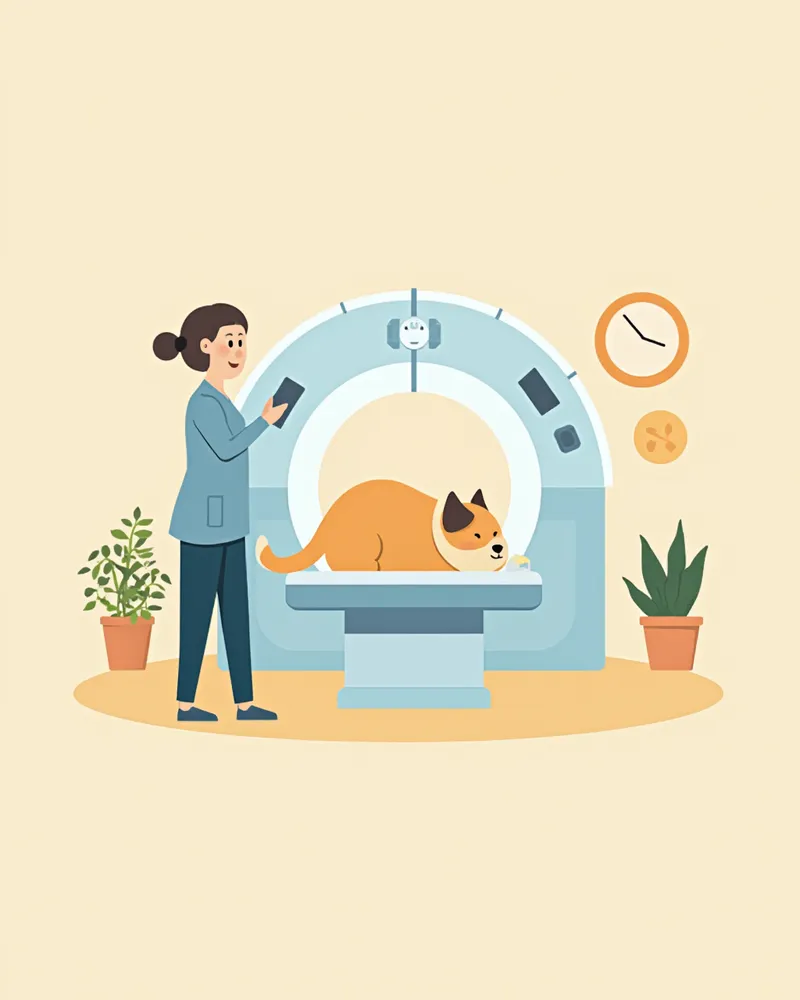
To reach an accurate diagnosis, we perform a series of stepwise examinations. First, an otoscopic exam is used to determine the location and size of the mass within the external ear canal. Next, a fine-needle aspiration (FNA) is performed to collect cells for an initial assessment of the tumor’s nature. A definitive diagnosis is established through a histopathological examination (biopsy). According to veterinary radiology textbooks, CT or MRI imaging is essential for evaluating the extent of tumor spread into the middle ear and brain. If malignancy is suspected, we also check for metastasis to the lymph nodes and lungs.
Illustration of a dog undergoing a CT scan with a veterinarian

Treatment Options — Surgery Is the Standard

Treatment for ear tumors in dogs varies depending on the tumor’s location and malignancy.
Lateral Ear Canal Ablation (LECA): Chosen for benign tumors located on the outer part of the external ear canal.
Total Ear Canal Ablation (TECA): A surgery that removes the entire external ear canal, performed when there is a high risk of recurrence or involvement of the middle ear.
Radiation Therapy: Used for tumors in locations where surgery is difficult or for residual tumor tissue.
Chemotherapy: Administered for malignant tumors that have metastasized or as an adjuvant treatment after surgery.
Your veterinarian will review CT imaging to determine the most appropriate combination of treatments.

Post-Surgical Care Precautions

Total ear canal ablation (TECA) typically results in near-total hearing loss in the affected ear. However, by preventing chronic pain and recurrence, it often leads to a better quality of life in the long term. Common surgical complications include facial nerve paralysis (manifesting as drooping of one corner of the mouth and reduced blinking) and Horner’s syndrome. While these conditions are often temporary and resolve over time, they can occasionally be permanent. Your veterinarian will monitor your pet’s recovery to assess their condition. If reduced blinking due to facial nerve paralysis causes corneal dryness, you must use veterinarian-prescribed artificial tears to prevent corneal damage.

Preventing Recurrence and Daily Care

Ear tumors often develop from chronic otitis externa, so maintaining good ear health is key to preventing recurrence.
Weekly ear checks: Inspect each ear separately for foul odor, bleeding, or discharge.
Proper ear cleaning: Use a dedicated ear cleanser and avoid inserting cotton swabs deep into the ear canal.
Moisture control: Thoroughly dry the inside of the ears after bathing or swimming.
Regular check-ups: Have otoscopic examinations every three months during the first year after surgery, and every six months thereafter.
Weight and immune management: Obesity and allergies can predispose pets to recurrent otitis externa.
An illustration of a pet owner gently cleaning their dog's ears.

Reviewed by a veterinarian

Dr. Tony — Punnawat Phongkittirak

Dr. Tony — Punnawat Phongkittirak

Veterinarian

A veterinarian who majored in veterinary medicine at Khon Kaen University, Thailand, and completed the IVSA program at North Carolina State University in the United States. Drawing on clinical experience at animal hospitals, he works in the pet healthcare field and is dedicated to building a digital care environment that connects pet parents with veterinarians.

Frequently Asked Questions

I noticed a lump inside my pet’s ear. Is surgery absolutely necessary?
It depends on the size, location, and type of the mass. Small inflammatory polyps may be managed with medication, but if foul odor or bleeding persists for more than two weeks, a biopsy should be performed to determine whether surgery is necessary.
Will my pet lose all hearing after a total ear canal ablation (TECA)?
Most dogs will lose conductive hearing in the operated ear, but as long as the other ear remains healthy, they can hear well enough for everyday life. The relief from pain and odor significantly improves your pet’s quality of life.
Can benign tumors recur?
Yes, even benign thyroid tumors can recur if they are not completely removed. It is recommended to undergo follow-up examinations, such as endoscopy and CT scans, every 3 to 6 months after surgery.
How much will the treatment cost?
The cost varies significantly depending on the hospital, location, and extent of the tumor, so it’s difficult to provide an exact figure. For an accurate estimate covering the entire package—including CT scans, biopsies, surgery, and hospitalization—it’s best to get a direct quote from the clinic where your pet will be treated.
Is there a way to prevent it?
The most effective way to prevent chronic otitis externa is to treat it promptly and manage it to prevent recurrence. For dogs with allergies or seborrheic dermatitis, concurrent dermatological care can be beneficial.

Share

Related Guides

References

[1] BSAVA Manual of Canine and Feline Dermatology, 4th Edition — Chapter: Diseases of the Ear

[2] Notes on Canine Internal Medicine, 4th Edition — Deafness and Ear Disorders

[3] Withrow & MacEwen's Small Animal Clinical Oncology, 6th Edition — Tumors of the Ear

This information is based on veterinary literature and does not replace diagnosis or treatment. Please consult a veterinarian for specific health concerns.

Metapet Co., Ltd. | CEO: Park Sung-yong | Business Reg. No. 417-88-02562 | Seoul, South Korea | Customer Center

Dog Ear Tumors (Ear Canal Tumors): Symptoms & Treatment | Meongsiljang