
Like
Share
멍실장
고양이 치주질환 단계별 관리 자주 묻는 질문 Q&A — 보호자가 꼭 알아야 할 핵심

Feline Periodontal Disease Stage-by-Stage Management FAQ — Key Points Pet Owners Must Know

Oral HealthQ&AMeongsiljang Veterinary Advisory Board

Feline periodontal disease is asymptomatic in its early stages, but as it progresses, it can lead to serious complications. We’ve outlined the stage-by-stage management strategies and interventions that pet owners need to know.

Awareness of Pet Owners Determines Stage-by-Stage Management of Feline Periodontal Disease

A veterinarian examining a cat's mouth.
Feline periodontal disease often shows few visible symptoms in its early stages, and most cats tend to hide their pain. Therefore, gum bleeding during brushing or probing is typically the first noticeable sign. - Early stage (gingivitis): The gums become red and may bleed slightly during brushing. Since the inflammation is confined to the gums, it can often be reversed with proper home care. - Intermediate stage: Bad breath begins to develop, the gums start receding from the teeth, and periodontal pockets form. - Advanced stage: Loss of the alveolar bone causes teeth to become loose, making it difficult for the cat to eat. - Severe stage: Teeth may fall out, and pain can lead to drooling, pawing at the mouth, decreased appetite, and weight loss. Because gingivitis is reversible if caught early, regular veterinary check-ups are essential. The earlier the condition is detected, the better the treatment outcome.

Periodontal Disease Is Divided Into 4 Stages, Each With Distinct Characteristics
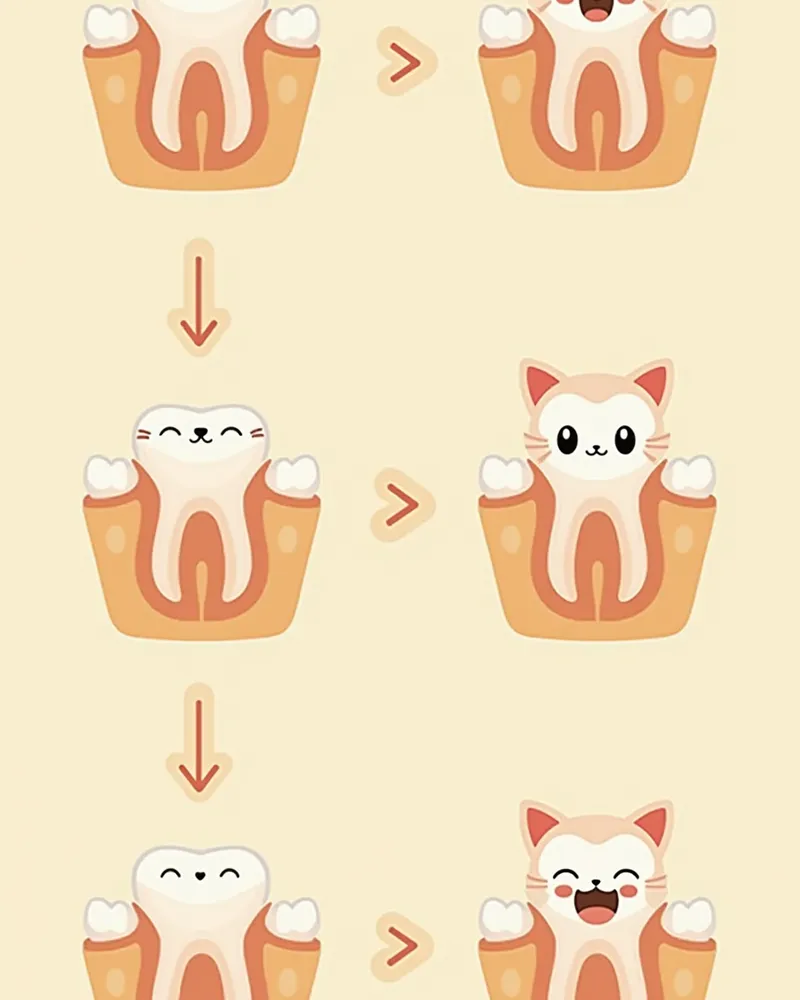
Feline periodontal disease begins as reversible gingivitis, an inflammation of the gums, and progresses to periodontitis, where the tissues supporting the teeth are destroyed. - Early stage (gingivitis): The gums become red and may bleed slightly during brushing. Since the inflammation is confined to the gums, it can often be resolved with proper home care. - Intermediate stage: Bad breath worsens, the gums recede, and periodontal pockets form. - Late stage: Loss of the alveolar bone causes teeth to become loose, and a decreased appetite leads to weight loss. Once lost, the alveolar bone generally does not regenerate. - Severe stage: Teeth may fall out, and severe pain can result in excessive drooling and a decline in daily activity levels. Because treatment and management strategies vary by stage, accurate diagnosis through an oral examination under anesthesia and dental radiographs is essential.
A diagnostic chart showing the four stages of feline periodontal disease

Accurately Identify Symptoms and Characteristics of Periodontal Disease by Stage

In the early stages of feline periodontal disease, the gums become red, but there are few outward signs. Bleeding during brushing or probing is often the first noticeable indicator. - Early symptoms: Gums appear red, and bleeding may occur during brushing or probing. - Moderate symptoms: Bad breath worsens, gums recede, and periodontal pockets form. - Advanced symptoms: Alveolar bone loss causes teeth to become loose, and appetite decreases. - Severe symptoms: Pain leads to drooling, pawing at the mouth, dropping food, and weight loss. Understanding the differences between these stages and detecting the disease early are key to effective treatment. Since most cats hide their symptoms, regular observation and veterinary check-ups are essential.
Cats having difficulty eating

Learn Treatment Methods and Management Strategies by Stage

In the early stage (gingivitis), consistent at-home dental care can reverse the condition, and professional scaling can be used for management when necessary. - Early-stage treatment: At-home care such as brushing, dental cleaners, and treats formulated to prevent periodontal disease can help prevent or resolve gum inflammation. - Mid-stage treatment: Supragingival and subgingival scaling and periodontal pocket treatment are required under anesthesia. - Late-stage treatment: Extraction may be unavoidable for teeth that are loose, have furcation defects, or have deep periodontal pockets. - Severe-stage treatment: Alongside extractions, adjunctive therapies such as pain relief and nutritional management are provided. The earlier the intervention, the more teeth can be preserved and the better the quality of life, making collaboration with your veterinarian most important.
A scene showing a veterinarian cleaning a cat’s teeth under anesthesia.

Comparison of Stage-by-Stage Treatment and Management Methods for Periodontal Disease

ItemMain SymptomsTreatment MethodManagement Points
Stage 1 (Gingivitis)Red gums, bleeding on probing/brushing, minimal tartarAt-home dental care, regular scalingDaily toothpaste use, toothbrush training (reversible stage)
Stage 2 (Mild periodontitis)Bad breath, gum recession, periodontal pocket formationScaling under anesthesia, periodontal pocket treatmentVeterinarian-recommended toothpaste, more frequent tartar removal
Stage 3 (Moderate periodontitis)Alveolar bone loss, loose teeth, pain, decreased appetitePossible extraction of loose teeth, specialized treatmentPost-anesthesia recovery care, pain management
Stage 4 (Severe periodontitis)Tooth displacement/loss, risk of pathological jaw fractureExtraction, surgical treatmentNutritional supplementation, pain relief, regular check-ups

The timing of treatment varies by stage, so early detection is key.

Visit the Vet Immediately If There Is Severe Bad Breath or Refusal to Eat

If your cat has severe bad breath or difficulty eating, it may have reached an advanced stage of periodontal disease. At this point, pain can become significant, and decreased appetite may lead to weight loss. Consult your veterinarian immediately for a diagnosis under anesthesia.

Prevention Is Far More Important Than Stage-by-Stage Management

Periodontal disease is far more effectively prevented than treated. In particular, gingivitis can be prevented or even reversed with consistent at-home dental care. - Prevention Method 1: Establish a tooth-brushing routine from an early age. Early initiation is crucial because approximately 70% of cats show some degree of periodontal disease by age three. - Prevention Method 2: Utilize dental treats and products designed to prevent periodontal disease. - Prevention Method 3: Schedule regular oral examinations with your veterinarian. - Prevention Method 4: Monitor for bad breath and changes in eating habits daily. Your consistent attention and habits are the most effective preventive measures. Early prevention helps maintain your cat’s health and quality of life for longer.
A cat chewing on a dental care treat

Checklist for Managing Feline Periodontal Disease

To effectively manage your cat’s periodontal disease, be sure to check the following:
Check for bad breath: Monitor your cat’s breath daily, as periodontal disease is the most common cause of halitosis. Inspect gum condition: Look for redness or bleeding. Observe changes in eating habits: Watch for dropping food or chewing on one side. Check for loose teeth: See if any teeth are loose. Regular check-ups: Have your cat’s mouth examined by a veterinarian on a regular basis. Preventive habits: Consistently brush your cat’s teeth or provide periodontal disease-preventive treats. Watch for pain signals: If your cat avoids having its mouth touched, drools excessively, or has difficulty swallowing food, visit the clinic immediately.
Checklist for Managing Feline Periodontal Disease

Reviewed by a veterinarian

Dr. Tony — Punnawat Phongkittirak

Dr. Tony — Punnawat Phongkittirak

Veterinarian

A veterinarian who majored in veterinary medicine at Khon Kaen University, Thailand, and completed the IVSA program at North Carolina State University in the United States. Drawing on clinical experience at animal hospitals, he works in the pet healthcare field and is dedicated to building a digital care environment that connects pet parents with veterinarians.

Frequently Asked Questions

Why is it difficult to detect feline periodontal disease in its early stages?
Cats are skilled at hiding pain and rarely open their mouths, so most patients show few outward symptoms in the early stages. Because gingivitis causes minimal visible changes and is prone to delayed diagnosis, regular check-ups are essential.
How do I brush my pet’s teeth at home?
Use cat-specific toothpaste and toothbrushes to brush your cat's teeth daily. At first, apply a small amount of toothpaste to your finger and gradually get your cat used to it. Consistent oral care at home can prevent or even reverse gingivitis. Never use human toothpaste.
If periodontal disease progresses, does the tooth need to be extracted?
If a tooth is loose, has furcation defects, or deep periodontal pockets, extraction may be necessary. This treatment is aimed at improving your cat's quality of life. The veterinarian will assess the situation and make the decision.
What products are effective for preventing periodontal disease?
There are cat-specific toothpastes, toothbrushes, tartar-control treats, and water additives. It’s important to choose products recommended by veterinarians and use them consistently.
How long does the recovery period take after periodontal disease treatment?
The recovery period varies depending on the extent of the treatment and the cat’s condition. Pain management and dietary adjustments are necessary, and you should monitor your cat’s recovery as directed by your veterinarian.

Share

Related Guides

References

[1] Clinical Medicine of the Dog and Cat, 4th Ed, 2023

[2] The Cat, Clinical Medicine and Management, 2nd Edition, 2021

[3] Handbook of Veterinary Pharmacology, 2022

This information is based on veterinary literature and does not replace diagnosis or treatment. Please consult a veterinarian for specific health concerns.

Metapet Co., Ltd. | CEO: Park Sung-yong | Business Reg. No. 417-88-02562 | Seoul, South Korea | Customer Center

Cat Periodontal Disease: Stage-by-Stage Management & 5 Key Questions | Meongsiljang