Like
Share
멍실장
비숑 안과 질환 완벽 가이드 (눈물·각막)

Bichon Eye Diseases — A Complete Guide to Causes of Tear Stains and Corneal Issues, and Management

Eye HealthBreed HealthMeongsiljang Veterinary Advisory Board

Bichon Frises are particularly prone to excessive tearing and corneal diseases. Here’s a summary of the causes, prevention, and management methods based on veterinary ophthalmology textbooks.

Why Are Bichon Frises Prone to Eye Diseases?

A close-up photo of a Bichon Frise's face
Bichon Frises are a small breed prone to excessive tearing and tear staining. Veterinary ophthalmology research indicates that the patency and curvature of the nasolacrimal duct can affect tear drainage. Therefore, care should not end with simply wiping away tear stains, but should focus on identifying the underlying causes of impaired tear drainage. Conditions such as entropion (inward rolling of the eyelids), distichiasis (abnormal eyelashes), and tear film abnormalities (keratoconjunctivitis sicca) can themselves cause corneal ulcers, so they should not be dismissed as mere cosmetic issues. Even if symptoms appear mild, early ophthalmic examination is important to identify any hidden causes.

Top 4 Common Eye Conditions in Bichons

Bichon owners most commonly encounter four main eye issues: - Epiphora (excessive tearing): Narrowing or blockage of the nasolacrimal duct causes tears to overflow onto the face, staining the fur brown. - Corneal ulcer: An erosion of the cornea, the transparent front layer of the eye, leading to pain, redness, and severe discharge. - Entropion: A structural condition where the eyelid rolls inward, causing eyelashes to rub against and irritate the cornea. - Tear-stain dermatitis: A secondary infection where bacteria and yeast proliferate in the damp fur beneath the eyes, resulting in red, inflamed skin.

Why Epiphora (Excessive Tearing) Is Particularly Frequent

Bichons are prone to tear staining, but in many cases, the issue stems less from the volume of tears produced and more from anatomical factors affecting the tear drainage pathway. Veterinary ophthalmology research indicates that in small breeds such as Poodles, the patency and curvature of the nasolacrimal duct can significantly influence tear drainage. When the nasolacrimal duct is narrow or stenotic, tears may fail to drain properly into the nose and instead overflow onto the face. This effect is often exacerbated by the long hair around the eyes, which allows tears to spread and leave more prominent brownish stains.
Anatomical explanation of tear stains under the eyes in Bichons, with an image

Simple Tear Stains vs. Pathological Epiphora: Differentiation Chart

ItemSimple tear stainingPathological epiphora
Eye rednessAbsentPresent
Character of eye dischargeClear and transparentYellow/green mucus
BlinkingNormalFrequent/excessive
Eye rubbingRareRepeated
OdorFaint yeasty smellStrong foul odor
ResponseHome care/groomingImmediate ophthalmic care

If any one item falls on the 'pathological' side, an ophthalmic examination is needed

These Signs Suggest Corneal Ulcer — Visit the Vet Within 24 Hours

If you notice any of the following signs, your pet may be suffering from an urgent eye condition such as a corneal ulcer or laceration. Because corneal damage can worsen and deepen over time, it’s crucial not to wait and see. - One eye is severely squinting or kept closed - Repeated rubbing of the eye with the paw or against furniture - A cloudy gray or blue spot visible on the cornea - Persistent discharge resembling yellow pus - The white part of the eye appears bright red due to bloodshot vessels

At-Home Eye Health Care Practices for Bichons
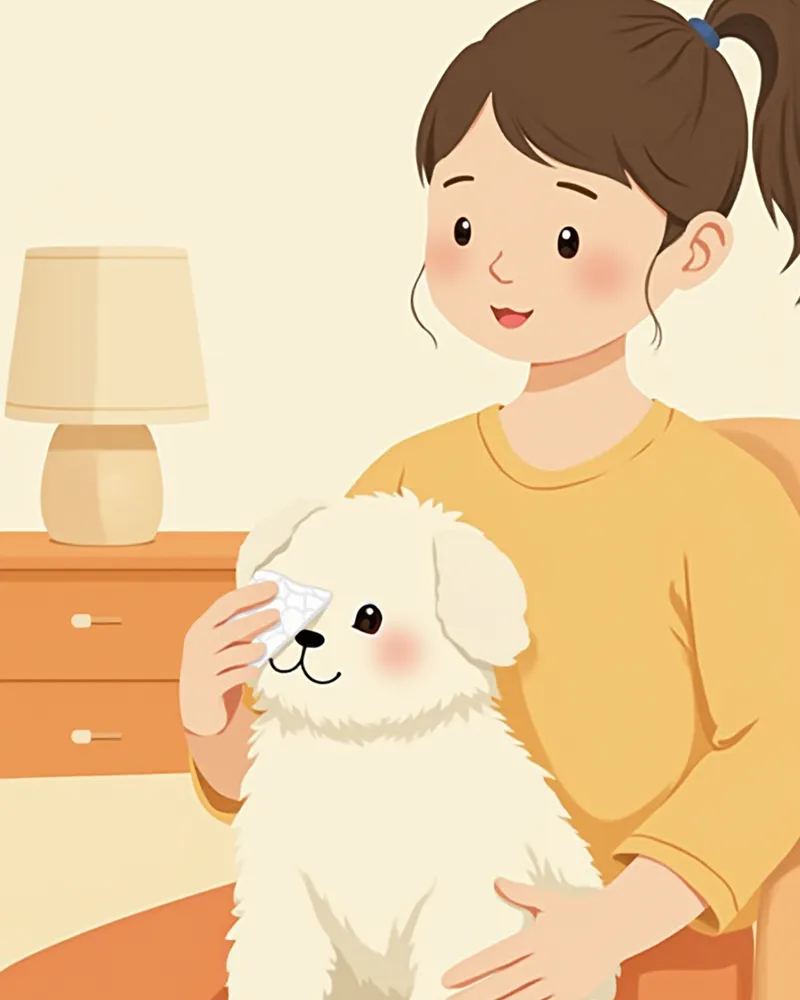
The key to Bichon eye care is minimizing irritation and keeping the area dry. - Trim hair around the eyes: Trim the hair around the eyes short every 2–3 weeks to prevent eye pricks. - Daily tear wiping: Wipe the area below the eyes 1–2 times daily with gauze moistened with saline solution. - Dry damp fur: After wiping, thoroughly dry the area with a dry tissue to prevent yeast overgrowth. - Avoid alcohol and human cleansers: These can strongly irritate the cornea and skin, potentially causing inflammation. - Remove irritants: Do not use cigarette smoke, diffuser fragrances, or dry spray near the eyes.
A guardian gently wiping the area around a Bichon’s eyes.

The Impact of Diet and Nutrition on Tear Stains

Veterinary nutrition textbooks note that the clinical evidence supporting certain tear-stain-reducing diets remains limited. However, there are a few principles you can start applying right now: - Single-protein diet trial: If you suspect allergies are contributing to increased tearing, you may try a diet trial with a novel protein source for an adequate period. Always consult your veterinarian regarding the duration and method. - Omega-3 supplementation: While omega-3s may help manage overall inflammation, including ocular health, direct clinical evidence for improving tear stains is limited. Always determine the appropriate dosage after consulting your veterinarian. - Provide clean drinking water: Ensuring your pet always has access to fresh, clean water supports overall health. Always consult your veterinarian before changing your pet’s diet, and make any transitions gradually.

Recommended Eye Examination Schedule for Bichon Owners

Even if your Bichon shows no symptoms, an annual eye exam is recommended. This becomes especially important as they reach middle age, since the risk of developing cataracts and dry eye (keratoconjunctivitis sicca) increases. Early-stage cataracts are invisible to the naked eye, so assuming your dog’s eyes are fine just because they look clear can be dangerous. If your regular veterinary clinic doesn’t have specialized ophthalmic equipment, we recommend scheduling at least one annual check-up at a veterinary ophthalmology clinic.

Reviewed by a veterinarian

Dr. Tony — Punnawat Phongkittirak

Dr. Tony — Punnawat Phongkittirak

Veterinarian

A veterinarian who majored in veterinary medicine at Khon Kaen University, Thailand, and completed the IVSA program at North Carolina State University in the United States. Drawing on clinical experience at animal hospitals, he works in the pet healthcare field and is dedicated to building a digital care environment that connects pet parents with veterinarians.

Frequently Asked Questions About Bichon Eye Care

Is it safe to give my pet a supplement for removing tear stains?
Over-the-counter tear stain supplements vary widely in ingredients and efficacy, and there is currently limited clinical evidence from a veterinary nutritional standpoint to support their effectiveness in improving tear stains. Because long-term use can lead to side effects depending on the ingredients, we do not recommend self-purchasing or administering these supplements long-term without first consulting your veterinarian.
My pet’s under-eye area is red and irritated. Is there an ointment I can apply to help?
Never use human eye ointments or steroid-based ointments. If there is corneal damage, steroids can rapidly worsen ulcers. Always use veterinarian-prescribed eye drops.
Can Bichons undergo cataract surgery?
Bichons, like other breeds, can undergo cataract surgery, such as phacoemulsification with aspiration. However, the decision is made after evaluating retinal function to ensure the retina is functioning normally. Consultation with a veterinary ophthalmology specialist is necessary.
Is surgery for excessive tearing really necessary?
Most Bichons can be managed effectively without surgery. However, if the nasolacrimal duct is completely blocked or if entropion is present, surgical options such as medial canthoplasty may be considered. The final decision should be made by a veterinary ophthalmologist.

Share

Related Guides

References

[1] Esson DW and Calvarese S (Eds.), Clinical Atlas of Canine and Feline Ophthalmic Disease, 2nd Ed, Wiley-Blackwell, 2022

[2] Gelatt KN et al., Veterinary Ophthalmology, Vol. 2, Wiley-Blackwell, 2013

[3] Ny Y et al., Medial canthoplasty for epiphora in dogs: a retrospective study of 23 cases, J Am Anim Hosp Assoc, 2006;42:435-439

[4] Seo KM and Nam TC, Tear formation, the patency and angle of bend of nasolacrimal duct in poodle dogs, Journal of Veterinary Clinics

This information is based on veterinary literature and does not replace diagnosis or treatment. Please consult a veterinarian for specific health concerns.

Metapet Co., Ltd. | CEO: Park Sung-yong | Business Reg. No. 417-88-02562 | Seoul, South Korea | Customer Center

Bichon Eye Diseases: Tear Stains & Corneal Care Guide | Meongsiljang