
Like
Share
멍실장
호흡 정지 응급 대처 — 강아지·고양이 심폐소생술 골든타임 가이드

Emergency Response for Respiratory Arrest — Golden Time Guide for Dog and Cat CPR

RespiratorySymptomsMeongsiljang Veterinary Advisory Board

Respiratory arrest in dogs and cats is an emergency that requires immediate action within four minutes. We’ve outlined everything pet owners need to know, including how to confirm breathing has stopped, the correct sequence for rescue breathing and chest compressions, and when to transport your pet to the hospital.

What Is Respiratory Arrest in Dogs and Cats?

A pet owner checking for breathing next to a puppy that has stopped breathing
Respiratory arrest in dogs and cats is a life-threatening emergency in which breathing stops completely, preventing oxygen from reaching the lungs. Cardiac arrest (CPA) is even more critical, with a survival rate to discharge of only 6–7%. Therefore, survival hinges on how quickly you recognize the emergency and begin cardiopulmonary resuscitation (CPR). If your pet is unconscious and not breathing, quickly check the airway, breathing, and circulation (ABC) within 10–15 seconds. If you cannot definitively rule out respiratory arrest, do not hesitate—immediately open the airway and begin rescue breathing. At the same time, have a family member call a 24-hour animal hospital to arrange for transport.

Is Breathing Really Stopped? 3 Ways to Confirm

It’s easy to make a hasty, incorrect judgment in a panic. A state of very shallow breathing due to excitement, fainting, or hypothermia is different from true respiratory arrest. If your pet is unconscious, their chest isn’t rising and falling, and you feel no air when placing the back of your hand near their nose and mouth, it’s considered respiratory arrest. If their gums are pale or bluish, they’re already oxygen-deprived.

Differentiating Stages of Respiratory Status

ItemNormal BreathingDifficulty BreathingRespiratory Arrest
Breaths per Minute10–30 times40+ times or irregular0 times
Chest MovementRegularExaggerated or shallowNone
Gum ColorPinkPale / bluish tintBlue / gray
ConsciousnessClearAnxious / pantingUnresponsive
ResponseObserveMove to hospital immediatelyCPR + transport to hospital

If left unattended at the difficulty-breathing stage, it rapidly progresses to respiratory arrest.

Checklist for Signs Before and After Respiratory Arrest

If you notice any of the following signs, do not delay—immediately proceed to emergency response. - Unresponsiveness: No response in the eyes, ears, or legs when you call your pet’s name or gently tap them. - Respiratory arrest: The chest shows no rise or fall for more than 10 seconds. - Cyanosis: The tongue or gums turn gray or purple. - Dilated pupils: The pupils are enlarged and do not react to light. - Suspected foreign body obstruction: Your pet suddenly collapses after chewing on a ball, treat, or toy.
Checking the gum color and pupil response of an unconscious cat

Immediate Emergency Response Steps to Take Now

1) Lay the pet on its right side on a flat surface. 2) Use one hand to open the mouth, pull the tongue forward, and check for foreign objects (such as food, toys, or vomit). If any are present, remove them with your fingers. 3) Extend the neck to align the airway in a straight line. 4) Close the mouth, then place your mouth over the dog or cat’s nose and blow air for two seconds. If the chest rises, the breath was successful. 5) Continue artificial respiration at a rate of one breath every six seconds, while another family member immediately calls a 24-hour veterinary clinic to arrange transport.

If the Heart Has Also Stopped? Adding Chest Compressions
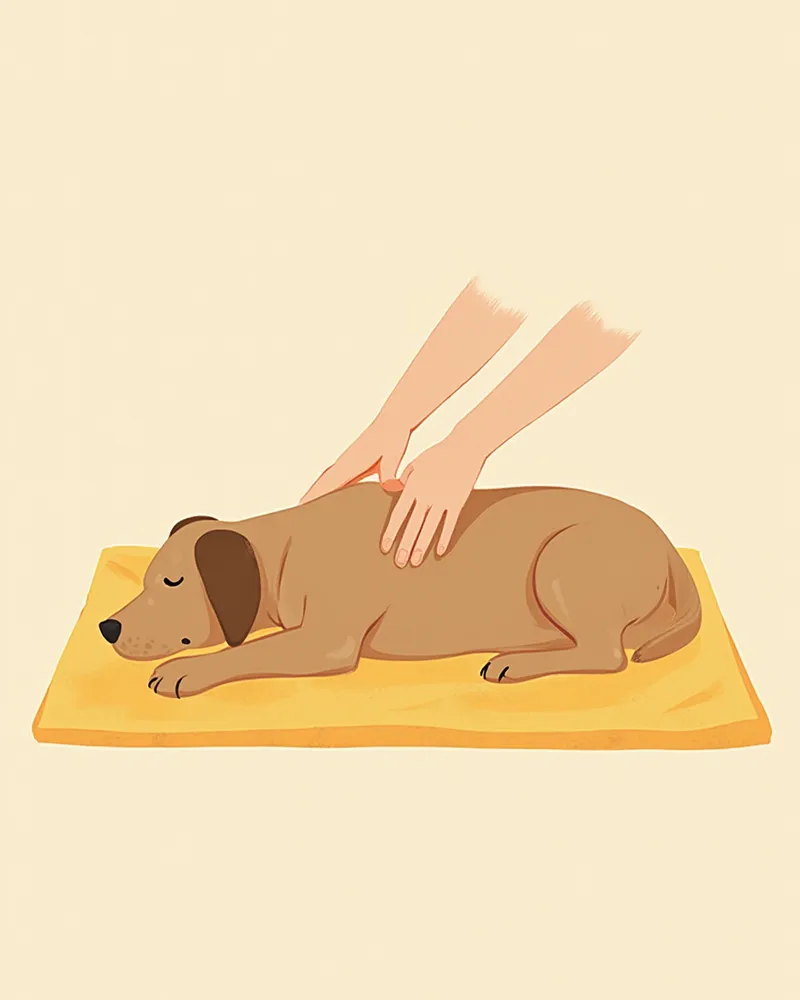
If you don’t feel a heartbeat (even when placing your hand on the chest wall behind the left front leg) or can’t detect a pulse, switch to CPR. Veterinary emergency textbooks recommend, unlike in humans, maintaining continuous compressions at a rate of 100–120 per minute while delivering one artificial breath every 6 seconds (approximately 10 breaths per minute). The key is to keep compressions uninterrupted rather than pausing for cycles like 30 compressions followed by 2 breaths. Compress the chest to a depth of one-third to one-half of its width. For small dogs and cats, wrap one hand around the entire chest to compress; for medium to large dogs, interlock both hands and press rapidly on the highest point of the chest. The person performing compressions should switch every two minutes to maintain consistent pressure.
How to perform chest compression CPR on a medium-sized dog

Common Causes of Respiratory Arrest

The first aid steps you should take before reaching the emergency room vary slightly depending on the cause. - Foreign body airway obstruction: Your pet suddenly struggles to breathe after swallowing a ball, treat, or string. Open their mouth and remove the foreign object first. - Brachycephalic respiratory distress: Breeds like Pugs, French Bulldogs, Pekingese, and Persians can experience airway blockage due to excitement or heat. Move them to a cool place immediately. - Worsening heart disease: A pet that has been repeatedly coughing or fainting suddenly stops breathing. - Traffic accidents or falls: Chest trauma can damage the lungs. Avoid pressing hard on the chest and head straight to the hospital. - Anesthesia or sedation side effects: If this occurs at the clinic, the veterinary medical team will respond immediately.

Important Precautions for Cats and Brachycephalic Breeds

Cats are prone to sudden respiratory distress under stress, so it is generally better to transport them to a veterinary clinic as quickly as possible rather than attempting prolonged chest compression at home. Brachycephalic breeds such as Pugs, French Bulldogs, Shih Tzus, and Persians have naturally narrowed airways, which puts them at risk of respiratory arrest even from excitement, heat, or air travel. Always consult your veterinarian before summer walks or long-distance travel, and never leave a pet with breathing difficulties in a sealed carrier or bag for an extended period.

Prevention and Management Points After Emergency Response

Once a dog has experienced an episode of apnea, the risk of recurrence is high. After discharge, monitor oxygen saturation and respiratory rate at home daily. If the underlying cause was pre-existing heart disease, tracheal collapse, or asthma, shorten the interval for regular veterinary check-ups to every three months or less. At home, remove any small toys, strings, cords, or treats that could be swallowed. For brachycephalic breeds, use a harness instead of a collar to avoid pressure on the neck. Avoid situations that can trigger excitement, overheating, overeating, or sudden exposure to cold water, such as cold showers.
A dog resting at home while monitoring its oxygen saturation after recovery from respiratory arrest

Reviewed by a veterinarian

Dr. Tony — Punnawat Phongkittirak

Dr. Tony — Punnawat Phongkittirak

Veterinarian

A veterinarian who majored in veterinary medicine at Khon Kaen University, Thailand, and completed the IVSA program at North Carolina State University in the United States. Drawing on clinical experience at animal hospitals, he works in the pet healthcare field and is dedicated to building a digital care environment that connects pet parents with veterinarians.

Frequently Asked Questions

How long should artificial respiration be performed?
Once you begin rescue breathing, continue without pause at a rate of one breath every six seconds until you arrive at the clinic. It is most important to maintain artificial respiration in the back seat of the vehicle during transport. If your pet starts breathing on its own en route, stop the rescue breathing and monitor their respiratory status.
I’m worried that my dog’s ribs might break during chest compressions.
Although rib fractures can occasionally occur, survival is impossible without chest compressions in cases of cardiac arrest. Therefore, it is far more important to begin proper compressions than to worry about potential complications. Do not hesitate; perform continuous chest compressions at a rate of 100 to 120 per minute, with a depth equal to one-third to one-half of the chest width.
Even though my pet started breathing on its own, do I still need to go to the vet?
Yes, it’s absolutely necessary to go. Even if breathing has returned, the underlying heart, lung, or brain issues remain. Recurrence within 24 hours is common, so emergency monitoring and imaging tests are essential.
Does the same approach work for cats?
The basic principle is the same, but cats are much smaller and have shallower chests. Use two fingers to encircle the chest, or gently wrap one hand around the entire thorax in a circular motion to apply pressure. Never press down hard with both hands as you would with a dog.
Are there any emergency tools it’s helpful to have on hand at home?
It’s a good idea to keep a box with the contact information for a 24-hour animal hospital, a carrier, a blanket, a small flashlight (for checking gum color and pupil response), and a pair of small gloves. You’ll also find it genuinely helpful to tape a pet-specific CPR card (summarizing the ABC steps) to your refrigerator.

Share

Related Guides

References

[1] King LG, Textbook of Respiratory Disease in Dogs and Cats, Saunders, 2004

[2] Fletcher DJ, Boller M et al., RECOVER evidence and knowledge gap analysis on veterinary CPR, J Vet Emerg Crit Care, 2012

[3] Plunkett SJ, McMichael M, Cardiopulmonary resuscitation in small animal medicine: an update, J Vet Intern Med, 2008

This information is based on veterinary literature and does not replace diagnosis or treatment. Please consult a veterinarian for specific health concerns.

Metapet Co., Ltd. | CEO: Park Sung-yong | Business Reg. No. 417-88-02562 | Seoul, South Korea | Customer Center

Respiratory Arrest in Dogs & Cats: CPR Golden Time | Meongsiljang