Like
Share
멍실장
강아지가 거울을 보고 짖거나 무시하는 이유는?

Why Does Your Dog Bark or Ignore Its Reflection in a Mirror?

Brain & CognitionQ&AMeongsiljang Veterinary Advisory Board

We’ve put together a guide to help you understand what it means when your dog barks, wags its tail, or completely ignores its reflection in a mirror, along with the cognitive science behind these behaviors and key points for pet owners to keep in mind.

What Is a Dog’s Mirror Reaction?

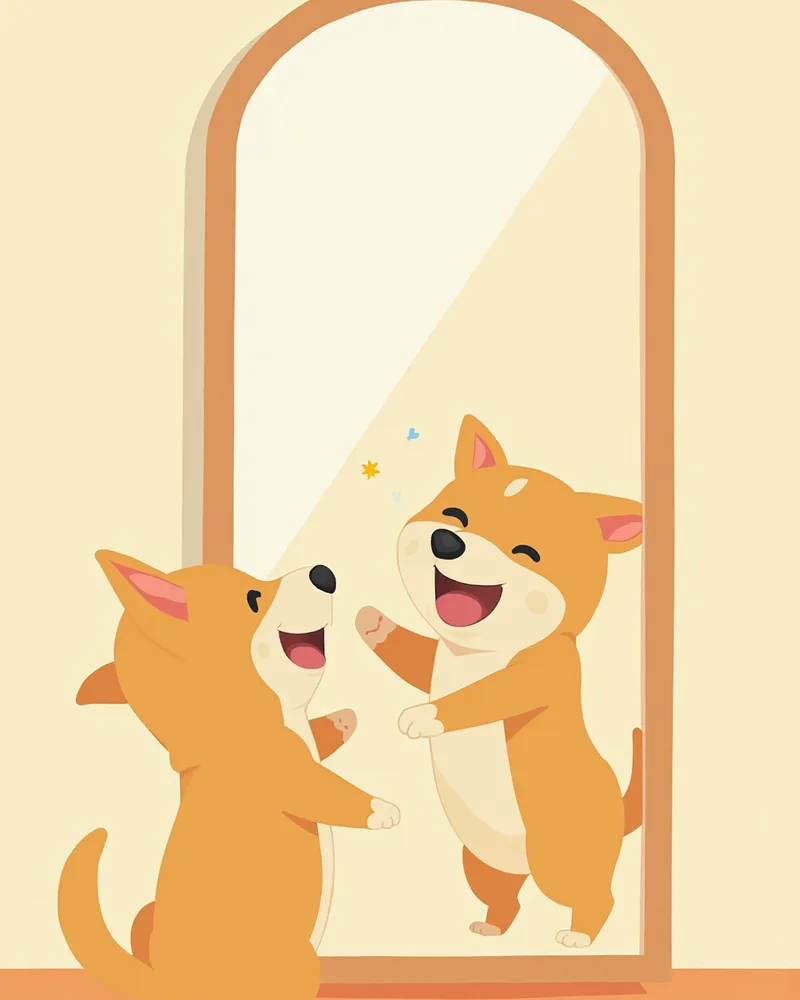
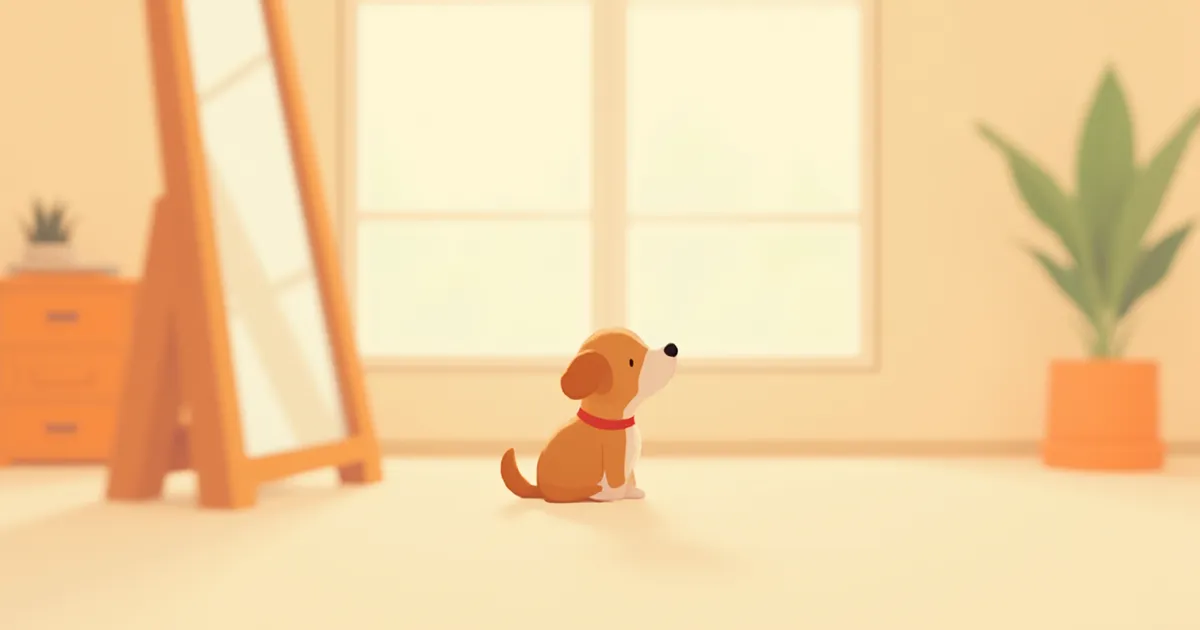
A dog sitting in front of a mirror, observing its own reflection
A dog’s mirror reaction refers to the behavior pattern in which a dog either perceives its reflection as an unfamiliar dog or simply ignores it. The key takeaway is that this reaction is mostly normal. Dogs process sensory information differently from humans, so they often quickly lose interest in a mirror image that provides only visual input without accompanying cues like scent or sound. In other words, rather than viewing a mirror reaction as a sign of abnormality, it is more accurate to understand it as a difference in how dogs process sensory information to interpret their environment. Even with the same stimulus, reactions can vary depending on age, personality, and experience.

Do Dogs Recognize Their Reflection as Themselves?

To put it simply, most dogs do not behave as if they recognize their reflection in a mirror as themselves. In animal cognition research, the Mirror Self-Recognition (MSR) test is used to determine whether an animal perceives its reflection as itself, and dogs often do not show clear visual responses indicating self-recognition in front of a mirror. However, this does not necessarily mean that dogs lack self-awareness. Because dogs rely more on senses such as smell and hearing than on vision, it is more accurate to understand that their self-awareness is simply not well demonstrated through a vision-based tool like a mirror.

Four Common Reactions to Mirrors

Dogs typically show one of four reactions when they see their reflection in a mirror, with each response shaped by their personality, past experiences, and age.
Barking and guarding: They perceive the reflection as an unfamiliar dog and interpret it as a threat.
Tail wagging and play bows: They mistake the reflection for a friendly dog and respond with social signals.
Indifference or ignoring: Lacking a scent, they conclude the reflection has no physical presence and lose interest.
Checking behind the mirror: They move behind the mirror to search for the source of the image.
Dogs showing various reactions when looking in the mirror

Differences in Mirror Reactions by Age and Personality

ItemPuppy (2–6 months)Adult Dog (1–7 years)Senior Dog (8+ years)
First reactionBarking, startlingIgnores after a brief investigationAlmost no reaction
DurationReacts for a long timeLearns after 1–2 timesLittle interest to begin with
Main motivationCuriosity, warinessSocial explorationSensory dulling
Guardian's responseUse treats to calmLeave it be naturallyAlso check vision and hearing

Individual variation is large; this table summarizes general tendencies

Why Are Dogs Confused by the “Scentless Image” in a Mirror?

Dogs prioritize their senses differently than humans do, relying heavily on information gathered through smell and hearing. In contrast, they have limited ability to judge things based on sight alone. For a dog to perceive something as a "real presence," visual cues are often accompanied by other sensory clues, such as scent or sound. Since a reflection in a mirror provides only movement and visual information, without any other sensory cues, a dog's brain likely processes it as a "visually weak stimulus" and quickly loses interest. This mismatch in sensory cues is a key to understanding dogs' reactions to mirrors. Additionally, as dogs age and their sensory functions change, their responses to the same stimuli may vary.

When to Consult a Vet About Mirror Reactions

While most mirror-related behaviors are normal, you should suspect a neurological or sensory issue if you notice any of the following patterns recurring: - Barking or lunging at the mirror continuously for more than 30 minutes - Staring at a non-reflective wall as if it were a mirror and repeating the behavior - A sudden disappearance of mirror-related reactions accompanied by disorientation - Repeatedly circling in one direction or standing with their head pressed against a wall These signs may indicate compulsive behavior, Canine Cognitive Dysfunction Syndrome (CDS), or a sudden decline in vision.

How to Handle Barking at Mirrors
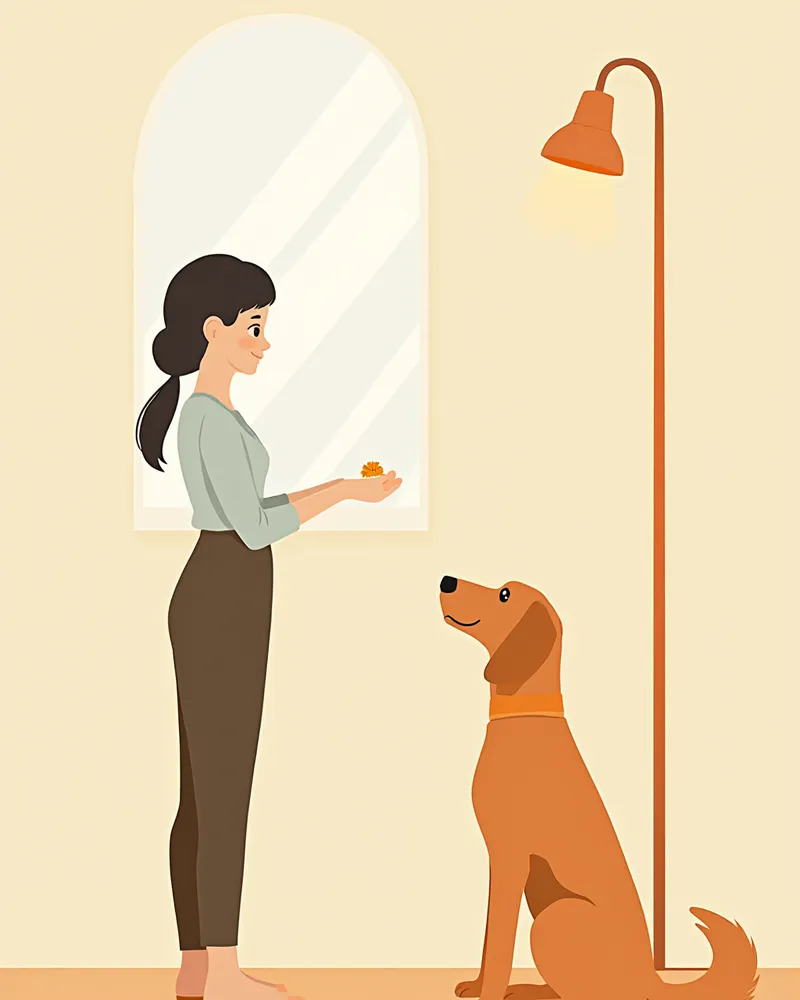
If your dog barks or gets overly excited in front of a mirror, desensitization is more effective than scolding.
Step 1 – Create Distance: Distract your dog with treats while standing 2–3 meters away from the mirror.
Step 2 – Short Exposure: Have your dog stay near the mirror for 1–2 minutes a day, rewarding calm behavior.
Step 3 – Scent Association: Place your dog’s blanket on the floor in front of the mirror to associate the space with their own scent.
Step 4 – Ignore Barking: Do not react when your dog barks, but praise them immediately when they become quiet.
Most dogs will calm down after repeating this process for 2–4 weeks.
A guardian training their dog with treats in front of a mirror

The Difference Between Mirror Reactions and Canine Cognitive Dysfunction Syndrome (CDS)

If your senior dog suddenly avoids mirrors or, conversely, appears disoriented and paces aimlessly in front of one, it may be a sign of Canine Cognitive Dysfunction Syndrome (CDS). CDS is a brain disorder in older dogs that is similar to dementia in humans. While a simple lack of interest in mirrors is not a concern, you should seek brain imaging and behavioral assessments if your dog fails to distinguish between walls and mirrors or gets lost in familiar spaces. For more information on the symptoms and management of cognitive dysfunction in senior dogs, please refer to our detailed guide.

Don’t Judge Intelligence Based on Mirror Reactions

A lack of clear response in a mirror self-recognition test does not mean your dog has low intelligence. Dogs perceive the world primarily through their sense of smell and hearing, relying less on vision. Since mirrors are inherently visual tools, they are not well-suited for assessing a dog’s ability to recognize itself. Therefore, mirror responses should be understood as differences in how dogs process sensory information, rather than as a measure of intelligence. Please avoid judging your dog’s intelligence based solely on visual cues and instead respect their unique sensory characteristics.

Reviewed by a veterinarian

Dr. Tony — Punnawat Phongkittirak

Dr. Tony — Punnawat Phongkittirak

Veterinarian

A veterinarian who majored in veterinary medicine at Khon Kaen University, Thailand, and completed the IVSA program at North Carolina State University in the United States. Drawing on clinical experience at animal hospitals, he works in the pet healthcare field and is dedicated to building a digital care environment that connects pet parents with veterinarians.

Frequently Asked Questions

Is it normal for my dog to be scared when looking in the mirror?
It’s completely normal for a puppy encountering a mirror for the first time to react this way. They see their reflection as a strange dog and become cautious. Rather than forcing them close, let them get used to it gradually over a few days, and most puppies will calm down.
Does wagging its tail in front of a mirror mean the dog recognizes itself?
Not at all. Dogs perceive their reflection as a friendly, unfamiliar dog and respond with social signals. If they recognized themselves, they would quickly lose interest.
Is it a problem if my dog doesn’t pay any attention to the mirror?
Everything looks normal. Since dogs rely heavily on their sense of smell, visual stimuli without an accompanying scent are often dismissed by them as "insubstantial." However, if your dog used to respond to these stimuli and suddenly stopped, it may be worth having their vision checked to rule out any decline.
Does mirror training help with a puppy’s brain development?
Exposure to a new environment is more beneficial for stimulating your pet's brain than the mirror itself. Mirrors are best used as a tool for desensitization training or as a social aid, and prolonged exposure is not recommended.
Should I take my senior dog to the vet if it stands staring blankly at a mirror?
If it happens only once in a while, it may not be a concern. However, if it occurs multiple times a day or is accompanied by signs of disorientation, it could indicate Canine Cognitive Dysfunction Syndrome (CDS). I recommend consulting with your veterinarian for a behavioral assessment.

Share

Related Guides

References

[1] Horowitz A., Smelling themselves: Dogs investigate their own odours longer when modified in an 'olfactory mirror' test, Behavioural Processes, 2017

[2] Gallup G.G., Chimpanzees: Self-Recognition, Science, 1970

[3] Bekoff M., Observations of scent-marking and discriminating self from others by a domestic dog, Behavioural Processes, 2001

This information is based on veterinary literature and does not replace diagnosis or treatment. Please consult a veterinarian for specific health concerns.

Metapet Co., Ltd. | CEO: Park Sung-yong | Business Reg. No. 417-88-02562 | Seoul, South Korea | Customer Center

Why Does Your Dog Bark at or Ignore Mirrors? | Meongsiljang