
Like
Share
멍실장
고양이 연조직육종 초기 증상과 진단·치료, 예후와 관리 가이드

Firm Lump Under a Cat’s Skin — Early Symptoms, Diagnosis, Treatment, and Prognosis Management of Soft Tissue Sarcoma

Oncology/CancerDiseasesMeongsiljang Veterinary Advisory Board

Feline soft tissue sarcoma is a malignant tumor that develops in soft tissues such as muscle, fat, and blood vessels. We’ve compiled essential information for pet owners, covering early symptoms, diagnostic and treatment methods, prognosis, and home care.

What Is Feline Soft Tissue Sarcoma?

A veterinarian palpating a cat’s neck and shoulder area to check for tumors
Feline soft tissue sarcomas are malignant tumors that arise in soft tissues such as muscle, fat, blood vessels, nerves, and connective tissue. Because they originate from connective tissue, they often have poorly defined borders and infiltrate surrounding tissues, making them difficult to detect early. They typically begin as firm lumps, and diagnosis is frequently delayed. Injection-site sarcomas (FISS), which develop at the site of injections, are a particularly important type to watch for in cats. If a lump at an injection or vaccination site measures 2 cm or larger, persists for more than one month, or grows rapidly over a short period, do not delay—bring your cat to a veterinary clinic for evaluation.

Causes and Pathogenesis

The exact cause of feline soft tissue sarcomas is not yet fully understood. The most well-known triggering factor is the administration of inactivated vaccines or medications containing adjuvants. In fact, inactivated vaccines with adjuvants have been reported to be more frequently associated with the development of these tumors than other types of vaccines. It is believed that the inflammatory and immune response to residual foreign material at the injection site disrupts the normal healing process of connective tissue, leading to abnormal cellular mutation and proliferation that forms a tumor. Chronic irritation from such residual foreign material at the injection site is also considered a contributing factor to the disease.

Key Symptom Checklist

Lumps under the skin: A firm lump appears that can be felt without pain when pressed.
Rapid growth: The size increases noticeably within four weeks.
Persistent changes at injection sites: A lump remains at the vaccination site (neck, shoulder, or thigh) for more than one month.
Skin redness and ulceration: The surface skin may turn red or break open like a wound.
Decline in overall condition: In advanced cases, appetite decreases and activity levels drop.
An anatomical illustration showing the main sites of feline soft tissue sarcoma

Signs Requiring Immediate Veterinary Visit

If your pet exhibits any of the following symptoms, please visit a veterinary clinic immediately: • A lump at the injection site persists for more than one month. • The lump is larger than 2 cm or has noticeably grown within four weeks. • There is ulceration or bleeding on the skin surface. • There is a complete loss of appetite or rapid weight loss.

Diagnostic Methods
Fine-needle aspiration biopsy: This is the initial test performed, using a thin needle to collect cells for a preliminary assessment of malignancy.
Biopsy: A punch biopsy or excisional biopsy is used to definitively determine malignancy and assign a tumor grade (Grade 1–3).
Thoracic radiographs and abdominal ultrasound: These are basic imaging tests to check for metastasis, with a focus on evaluating the lungs and lymph nodes.
CT scan: Recommended when the tumor is large or located in a complex area, this is essential for precise surgical planning.
The higher the tumor grade, the greater the risk of metastasis and the more the treatment approach may change. Confirming the exact grade through biopsy is the cornerstone of diagnosis.
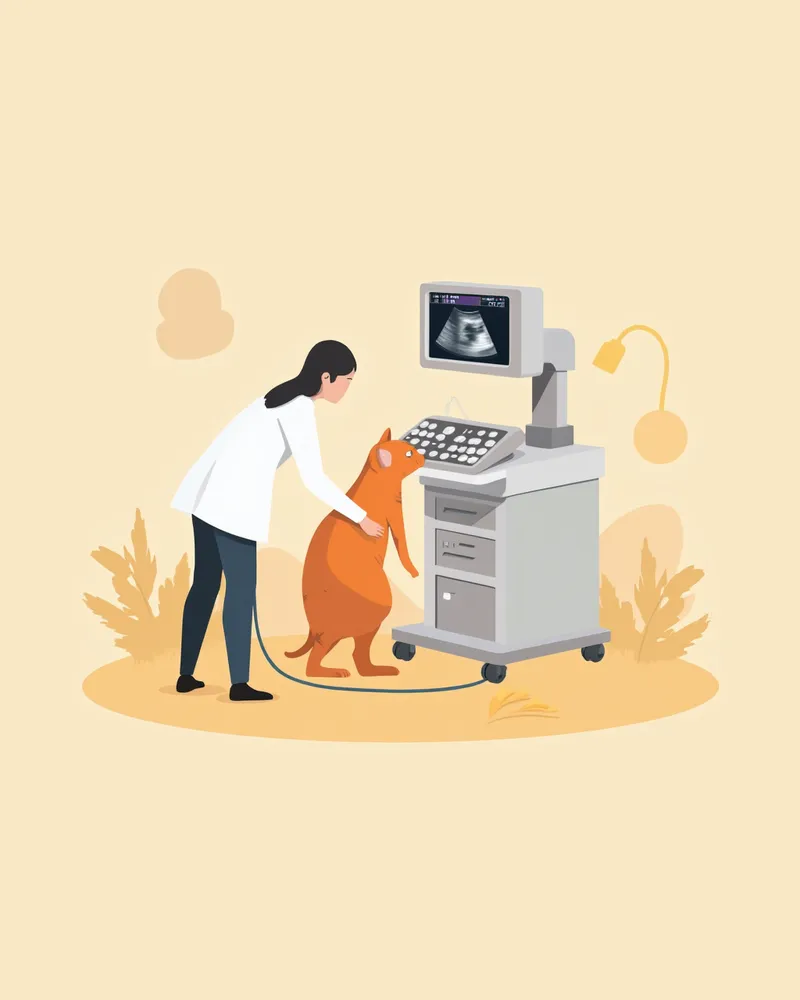
A veterinarian performing an abdominal ultrasound on a cat

Treatment Methods

Surgical excision: This is the most important treatment. The wider the surgical margins, the lower the recurrence rate.
Radiation therapy: Used as an adjunctive treatment before or after surgery. It is especially effective when surgical excision is incomplete.
Chemotherapy: In some cases, doxorubicin-based chemotherapy is used. It is primarily used for high-grade tumors with a high risk of metastasis.
Immunotherapy and targeted therapy: Currently being explored at some specialized oncology centers.
A veterinary surgical team performing a tumor removal surgery on a cat in the operating room.

Home Care Points

Wear the e-collar: Always keep the e-collar on to prevent your pet from licking or scratching the incision site, and continue using it until the wound has fully healed.
Regular palpation checks: Every two weeks, gently feel the surgical area and surrounding tissues with your hands to check for any new lumps or changes.
Environmental management: Provide a quiet, stable space to reduce stress, and limit excessive activity.
Symptom tracking: Record any changes in appetite, weight loss, or energy levels by date, and share this information with your veterinarian during regular check-ups.
Follow-up exams: Adhere strictly to scheduled check-ups every three months to detect any recurrence early.

Prevention Points for Feline Injection-Site Sarcoma (FISS)

Guidelines from organizations such as the American Association of Feline Practitioners (AAFP) recommend administering different vaccines at specific injection sites. It is important to minimize unnecessary injections and consult with your veterinarian to determine the appropriate injection site. After vaccination, make it a habit to regularly check the injection site for at least three months. Avoiding vaccinations altogether can pose greater risks, so the key is to proceed with proper vaccination protocols.

Reviewed by a veterinarian

Dr. Tony — Punnawat Phongkittirak

Dr. Tony — Punnawat Phongkittirak

Veterinarian

A veterinarian who majored in veterinary medicine at Khon Kaen University, Thailand, and completed the IVSA program at North Carolina State University in the United States. Drawing on clinical experience at animal hospitals, he works in the pet healthcare field and is dedicated to building a digital care environment that connects pet parents with veterinarians.

Frequently Asked Questions

Is feline soft tissue sarcoma contagious to other cats?
It is not contagious. Tumor cells do not spread to other cats.
What is the recurrence rate after surgery?
The outcome varies significantly depending on the extent of surgical excision. While wider, complete removal lowers the risk of recurrence, incomplete excision markedly increases it. Studies report local recurrence rates of approximately 40% even after complete excision, indicating that this tumor has a substantial tendency to recur. Therefore, combining postoperative radiation therapy to address any microscopic residual disease can significantly reduce the risk of recurrence.
What is the prognosis?
It depends on the tumor grade and whether it has metastasized. Grade 1 tumors generally have a relatively good prognosis after surgery, whereas grade 3 tumors carry a high risk of metastasis and often have a poor prognosis. Early detection is the most important factor.
Does a lump at the injection site always mean cancer?
Not at all. A small swelling after vaccination is common and usually goes away within 2 to 4 weeks. However, if it persists for more than a month, measures over 2 cm, or grows rapidly, your pet should be examined by a veterinarian.
What should I feed my pet after surgery?
Immediately after surgery, we recommend a highly digestible, high-protein prescription diet. Maintaining your pet’s body weight is crucial for recovery, so if they’re not eating, please consult your veterinarian about using appetite stimulants or supplemental feeding.

Share

Related Guides

References

[1] Liptak JM, Forrest LJ. Soft tissue sarcomas. In: Withrow SJ, Vail DM, eds. Withrow and MacEwen's Small Animal Clinical Oncology, 4th ed. Saunders Elsevier, 2007:425–454.

[2] Martano M, Morello E, Buracco P. Feline injection-site sarcoma: past, present and future perspectives. Vet J. 2011;188(2):136–141.

[3] Couto SS, Griffey SM, Duarte PC, et al. Feline vaccine-associated fibrosarcoma: morphologic distinctions. Vet Pathol. 2002;39(1):33–41.

[4] Little S, ed. The Cat: Clinical Medicine and Management, 2nd ed. Saunders Elsevier, 2022.

This information is based on veterinary literature and does not replace diagnosis or treatment. Please consult a veterinarian for specific health concerns.

Metapet Co., Ltd. | CEO: Park Sung-yong | Business Reg. No. 417-88-02562 | Seoul, South Korea | Customer Center

Feline Soft Tissue Sarcoma: Symptoms, Diagnosis & Treatment | Meongsiljang