Like
Share
멍실장
신생 강아지·고양이 응급 신호 한눈에 보기

When Are Newborn Puppies and Kittens in an Emergency? — A Guide to Critical Warning Signs You Must Not Miss

ImmunityQ&AMeongsiljang Veterinary Advisory Board

We’ve compiled the emergency signs that can appear in newborn puppies and kittens, along with the immediate steps pet owners should take, based on veterinary textbooks.

What Are Neonatal Emergencies?

A veterinarian’s hands checking the vitality of newborn puppies and kittens
Neonatal emergencies are life-threatening conditions such as hypothermia, hypoglycemia, and respiratory failure that occur in puppies and kittens within the first four weeks of life. Unlike adult animals, neonates cannot independently maintain their body temperature, blood sugar, or hydration levels, so their condition can deteriorate rapidly within hours once warning signs appear. In fact, studies have shown that newborns with low vitality scores immediately after birth face a higher risk of death within two hours, underscoring the critical importance of prompt intervention during the first few hours. Therefore, if you notice abnormal breathing, a cold body, or refusal to nurse, do not hesitate—contact an emergency veterinary clinic immediately.

Why Are Neonates Vulnerable to Emergencies?

Newborn puppies and kittens are born with high red blood cell concentrations, but they naturally experience “physiologic neonatal anemia,” during which their hematocrit (Hct) reaches its lowest point around 4 to 6 weeks of age. If Hct rises during this period, dehydration should be suspected. Because their liver and kidney metabolic and excretory functions, as well as their kidneys’ ability to concentrate urine, are still immature, they are highly vulnerable to dehydration. Additionally, a drop in body temperature can easily lead to ileus, a condition where intestinal motility ceases. According to veterinary textbooks, their thermoregulatory system remains immature until around 4 weeks of age, meaning even slight fluctuations in ambient temperature can cause hypothermia. Therefore, any moment when you sense something is “a bit off” should be treated as an emergency.

Normal Body Temperature, Heart Rate, and Respiratory Rate by Age

Item1 Week Old2–3 Weeks Old4 Weeks Old
Normal Body Temperature34.4–36.1℃36.1–37.7℃37.7–38.9℃
Heart Rate (per minute)About 180–200 beatsAbout 180–200 beatsAbout 180–200 beats
Respiratory Rate (per minute)15–35 breaths20–40 breaths20–40 breaths
Feeding Interval2 hours3 hours4 hours

Neonatal heart rate is reported to be in the normal range of about 180–200 beats per minute (per Advanced Monitoring for Small Animal Emergency and Critical Care). As they grow, it gradually decreases to about 110–120 in young dogs and about 130–140 in young cats, and by around 4 weeks of age the respiratory rate becomes 20–40 breaths per minute, the same as adults. There is species·individual variation.

Emergency Warning Signs Checklist You Must Check
If you notice any of the following signs, it is an emergency.
Hypothermia: The body feels cold and movements become sluggish (dangerous below 34°C).
Hypoglycemia: Tremors, seizures, or lethargy occur.
Refusal to nurse: The puppy does not feed for more than 4–6 hours.
Abnormal breathing: Panting, moaning, or a blue tongue (cyanosis) is visible.
Dehydration: The mouth feels sticky, and the skin does not snap back when pinched.
Changes in crying: The puppy cries loudly and continuously, unlike its usual behavior, or stops crying altogether.
Diarrhea and vomiting: In newborns, these symptoms can be fatal within just a few hours.
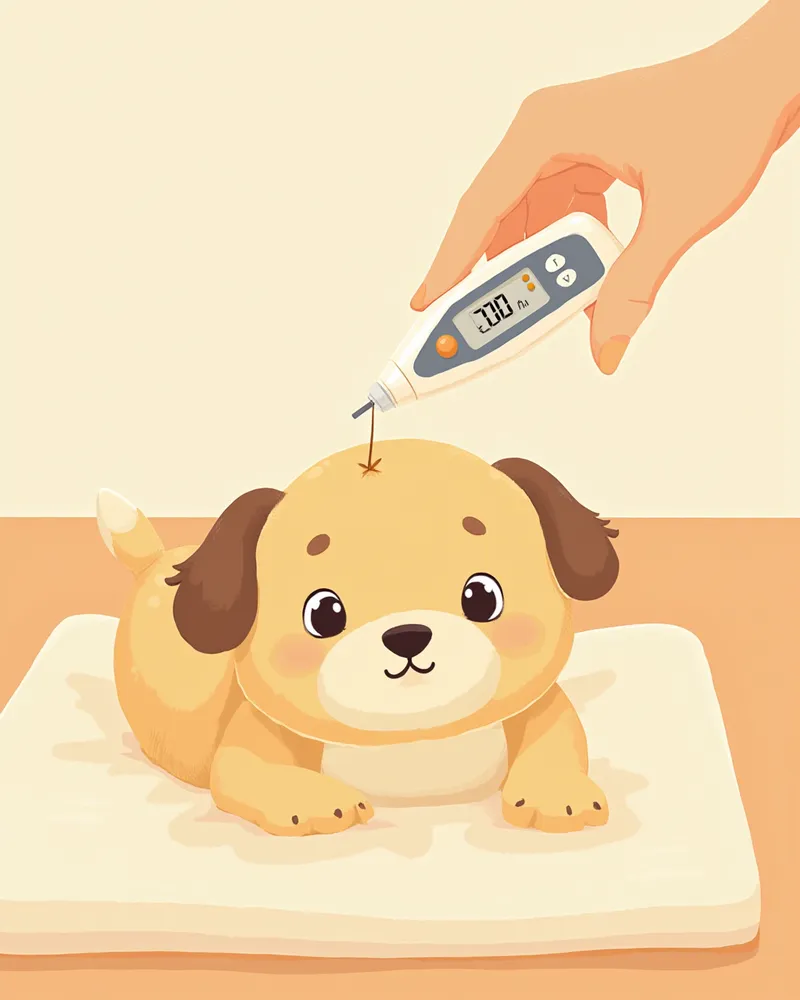
A guardian’s hand holding a thermometer to measure the body temperature of a newborn puppy

Criteria for Immediate Veterinary Care

If any of the following signs are present, seek immediate care at a 24-hour emergency veterinary hospital, even in the early hours: body temperature below 34°C, blue or pale gums and tongue, seizures or convulsions, a distended and firm abdomen, a respiratory rate of 15 breaths per minute or fewer, or panting lasting more than 20 minutes, and a mother dog rejecting or biting her puppies. During transport, wrap the puppy in a towel to maintain body temperature, and gently apply honey to the gums to help prevent hypoglycemia.

Immediate Emergency Steps You Can Take at Home

There is a specific sequence of steps you should follow while transporting your pet to the clinic. 1. Keep warm: Wrap your pet in a towel and place a warm water bottle (at human body temperature) next to them. Avoid direct contact to prevent burns. 2. Assist with hypoglycemia: Apply 1–2 drops of honey to the gums (do not pour it into the mouth if your pet cannot swallow). 3. Positioning: Slightly tilt the head downward to keep the airway open. 4. Record details: Write down when the symptoms started and what they were. Veterinary Emergency and Critical Care textbooks prohibit tube feeding in hypothermic patients due to the risk of intestinal stasis and aspiration pneumonia.
A caregiver wrapping a newborn kitten in a warm towel

Assessing Condition with the APVAR Score

In veterinary medicine, we assess newborn puppies and kittens using the APVAR score, a modified version of the human APGAR score. This system evaluates five key indicators—heart rate, respiratory effort, reflexes, movement, and mucous membrane color—each scored from 0 to 2 points, with the total score determining the overall condition. A score of 7 or higher indicates a healthy newborn, 4 to 6 suggests moderate risk, and 3 or below requires immediate emergency intervention. While it can be challenging to calculate an exact score at home, simply checking three things—whether the baby is breathing, responsive, and has pink-colored mucous membranes—can help you quickly determine if emergency care is needed.

Actions to Avoid

In an emergency, improper handling can cause even more harm. Do not apply a hot water bottle directly to a cold body (risk of burns and rapid vasodilation). Do not force milk or water on a hypothermic pet (risk of aspiration pneumonia). Do not pour honey into the mouth (if not swallowed, it can block the airway). Human medications (fever reducers, painkillers) are strictly prohibited. The most dangerous mistake is wasting time trying "home remedies" found online.

Reviewed by a veterinarian

Dr. Tony — Punnawat Phongkittirak

Dr. Tony — Punnawat Phongkittirak

Veterinarian

A veterinarian who majored in veterinary medicine at Khon Kaen University, Thailand, and completed the IVSA program at North Carolina State University in the United States. Drawing on clinical experience at animal hospitals, he works in the pet healthcare field and is dedicated to building a digital care environment that connects pet parents with veterinarians.

Frequently Asked Questions

My one-day-old puppy keeps crying. Is this an emergency?
Healthy newborn puppies usually sleep quietly after feeding. If a puppy cries loudly and continuously for more than two hours, it is likely due to hunger, hypothermia, or pain, and requires emergency veterinary care.
My mother dog isn’t caring for her puppies. What should I do?
If the mother dog ignores or pushes away her puppies, it may indicate a problem with the puppies or that the mother is unwell. Both situations require veterinary attention, and you should temporarily begin bottle-feeding and keeping the puppies warm.
Is it an emergency if the weight isn't increasing?
Newborn puppies should gain weight every day. If their weight fails to increase for more than 48 hours, or if they actually lose weight, it’s considered an emergency, and you should consult your veterinarian right away.
The symptoms started in the middle of the night. Is it okay to wait until morning?
Neonatal emergencies don’t wait until morning. Hypothermia, hypoglycemia, and respiratory distress can be fatal within hours, so head straight to a 24-hour emergency animal hospital.
Do cats and dogs require different emergency care for newborns?
The basic principles—keeping the animal warm, preventing low blood sugar, and transporting it to a vet quickly—are the same for both puppies and kittens. Newborns of both species cannot regulate their own body temperature and have higher fluid requirements than adults, making them prone to rapid dehydration. Therefore, maintaining body temperature and managing feeding intervals are equally important regardless of species.

Share

Related Guides

References

[1] Advanced Monitoring for Small Animal Emergency and Critical Care, 2nd Ed — Neonatal Resuscitation Chapter

[2] Small Animal Critical Care Medicine, 3rd Ed — Neonatal Sepsis & Emergency

[3] Veronesi MC et al., APGAR scoring in canine neonates, 2009

This information is based on veterinary literature and does not replace diagnosis or treatment. Please consult a veterinarian for specific health concerns.

Metapet Co., Ltd. | CEO: Park Sung-yong | Business Reg. No. 417-88-02562 | Seoul, South Korea | Customer Center

Newborn Puppy & Kitten Emergencies: Warning Signs | Meongsiljang