Like
Share
멍실장
고양이 종양 조직검사 — 마취 위험과 노령묘 검사 결정

Feline Tumor Biopsy — Anesthesia Risks and Decision-Making for Senior Cats

Oncology/CancerQ&AMeongsiljang Veterinary Advisory Board

We’ve compiled the essentials every cat owner should know—based on veterinary expert advice—including the differences between biopsy methods for feline tumors, anesthesia risks and safety protocols for senior cats, and criteria for determining the optimal timing for testing.

What Is a Feline Tumor Biopsy?

A gray cat calmly receiving a check-up in the hands of a veterinarian.
Feline tumor biopsy is a diagnostic procedure in which cells or tissue are sampled from a suspected lump or mass to distinguish between benign and malignant conditions and to confirm the exact diagnosis. Histopathological examination is, in fact, the only definitive method for confirming diagnoses of diseases such as tumors. What truly matters is not the test itself, but rather anesthesia safety and the timing of the procedure. Cats aged 11 years and older are generally considered senior, while those aged 15 and older are classified as geriatric. While advanced age alone is not a reason to avoid anesthesia, senior cats may be more sensitive to the suppressive effects of sedatives and anesthetics. Therefore, the biopsy method and timing must be carefully determined based on a comprehensive assessment of the tumor’s size and location, as well as the cat’s overall health status.

Why a Biopsy Is Essential

Even lumps that look similar on the surface can be malignant in a significant number of cases. For example, lesions on the ear pinnae are reported to have a high likelihood of being squamous cell carcinoma (SCC). Some tumors, such as mammary gland tumors, are known to have a high rate of malignancy, while others, like lymphoma and mast cell tumors, require histopathological examination to determine their type and grade. Because it is difficult to distinguish between benign and malignant tumors based solely on appearance and palpation, histopathological examination is essentially the only way to confirm a diagnosis. Therefore, it is standard practice to perform a biopsy on any mass suspected of being a tumor, regardless of its size or shape, as delayed diagnosis narrows treatment options.

Biopsy Methods — Three Levels of Invasiveness and Accuracy

Tissue biopsies are categorized by their level of invasiveness.
Fine Needle Aspiration (FNA): The simplest method, using a thin needle to extract cells for examination; it can usually be performed without anesthesia.
Tru-cut Biopsy: Involves using a larger needle to obtain a small tissue sample, requiring brief sedation or local anesthesia.
Excisional Biopsy: Removes the entire tumor for examination; while it requires general anesthesia, it allows for both diagnosis and treatment to be performed simultaneously.

Comparison of Biopsy Methods at a Glance

ItemFine-needle aspirationCore biopsyExcisional biopsy
Anesthesia neededUsually not neededSedation or partial anesthesiaGeneral anesthesia required
Accuracy60–80%85–90%95% or more
Recovery periodSame day1–2 days7–14 days
Cost range (KRW)50,000–150,000150,000–300,000400,000–1,200,000
Recommended situationLymph nodes/superficial nodulesInternal organs/deep massesResectable single tumor

Costs vary depending on the hospital, region, and tumor location

Increased Anesthesia Risks in Senior Cats
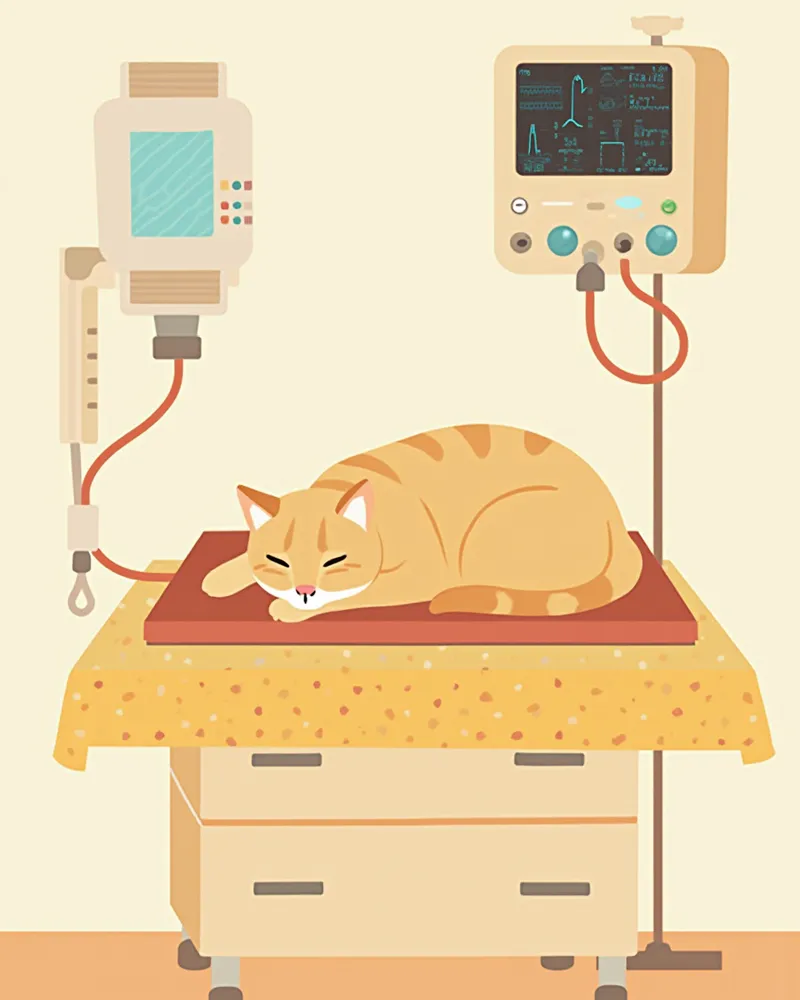
As cats age, their heart’s contractility and cardiovascular reserve decline, making them more prone to hypotension during anesthesia. Additionally, reduced kidney and liver function decreases the amount of anesthetic required, so the type and dosage of medications must be carefully adjusted. While age alone is not a reason to avoid anesthesia, senior cats are more sensitive to sedatives and anesthetics and have impaired thermoregulation, which increases the risk of hypothermia and delayed recovery. Therefore, for senior cats, safety depends more on pre-anesthetic evaluation and post-procedure monitoring than on the procedure itself. Be sure to verify that your veterinary clinic has a robust anesthesia and recovery support system in place.
An elderly cat resting comfortably on the operating table, monitored with anesthesia equipment.

Pre-Anesthetic Tests That Must Be Performed

For senior cats or those with chronic conditions, pre-anesthetic blood tests (complete blood count and biochemistry), chest X-rays, cardiac ultrasound, and blood pressure measurement are essential. If hidden conditions such as elevated kidney values, hypertrophic cardiomyopathy, or hyperthyroidism are present, the type and dosage of anesthesia must be carefully adjusted. For safety, it is advisable to avoid clinics that proceed with anesthesia without these preliminary examinations.

Six Safety Protocols for Anesthesia in Senior Cats
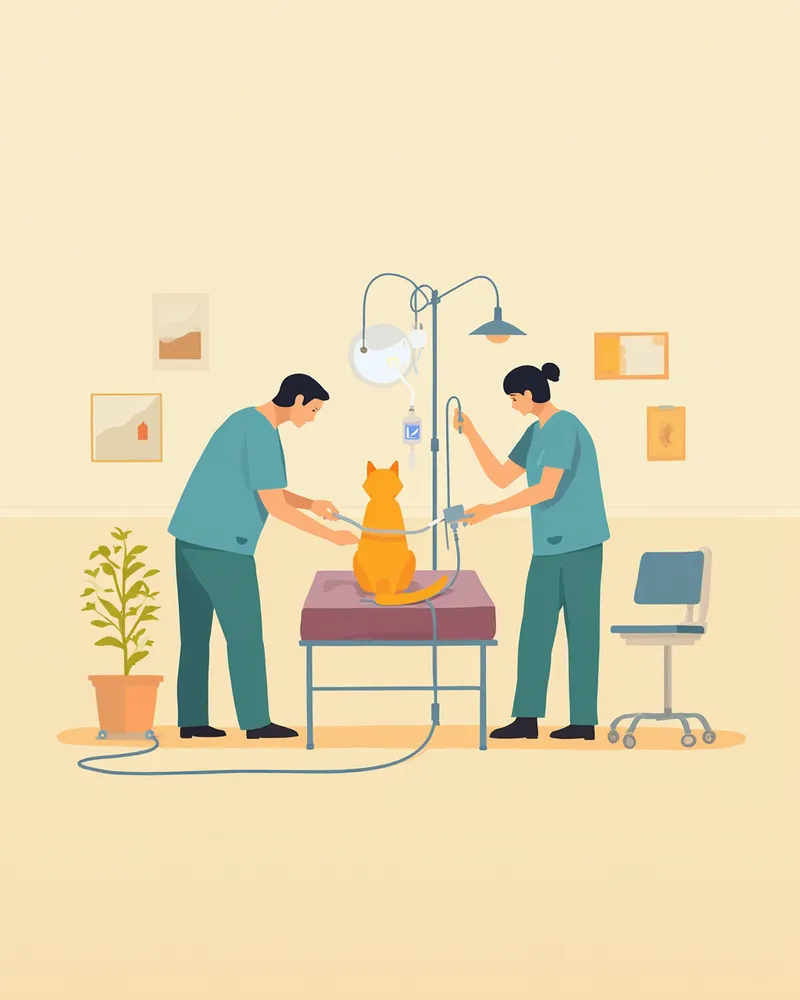
To ensure safety, the following measures must be in place:
Pre-anesthetic medication: Administer sedatives and analgesics before induction to reduce cardiovascular stress.
Endotracheal intubation: Secure the airway safely; this is essential for inhalant anesthesia.
Intravenous fluid therapy: Help maintain blood pressure and protect kidney function.
Continuous monitoring: Monitor ECG, blood pressure, oxygen saturation, and body temperature throughout the procedure.
Thermal management: Cats lose body heat rapidly during anesthesia, so a warming mat is necessary.
Dedicated recovery monitoring: A staff member should observe the patient closely until fully awake.
A cat under anesthesia with an endotracheal tube, intravenous fluids, and an electrocardiogram all in place.

The First 24–48 Hours of Recovery Are Critical

Cats can remain at risk even during the recovery phase after anesthesia, and senior cats in particular often experience a slower recovery. Therefore, monitoring during recovery is just as important as the anesthesia itself. Please closely observe your cat for at least 24 hours after bringing them home for signs such as loss of appetite, lethargy, abnormal breathing, low body temperature, bleeding, or changes in gum color. If you notice any unusual signs, it is safer to contact your veterinary clinic immediately rather than waiting for a follow-up appointment the next day.

Reviewed by a veterinarian

Dr. Tony — Punnawat Phongkittirak

Dr. Tony — Punnawat Phongkittirak

Veterinarian

A veterinarian who majored in veterinary medicine at Khon Kaen University, Thailand, and completed the IVSA program at North Carolina State University in the United States. Drawing on clinical experience at animal hospitals, he works in the pet healthcare field and is dedicated to building a digital care environment that connects pet parents with veterinarians.

Frequently Asked Questions

Are there cases where a biopsy can be postponed?
Small, benign-suspicious nodules that show little change in size and are painless and non-bleeding can be monitored for a period of time. However, if they grow rapidly or change shape within 1 to 2 months, immediate examination is necessary.
Is a fine-needle aspiration biopsy alone sufficient for diagnosis?
Lymph nodes and superficial masses can be diagnosed in over 60–80% of cases through fine-needle aspiration. However, if the results are inconclusive or malignancy is strongly suspected, a definitive diagnosis requires an incisional biopsy or excisional biopsy.
Is anesthesia safe for cats over 15 years old?
Age is not an absolute criterion. If the kidney, heart, and liver function assessments are stable and the tumor is life-threatening, proceeding with anesthesia is more beneficial. The decision is based on the results of the pre-anesthetic tests.
How long does it take to get the biopsy results?
Fine-needle aspiration results are typically available within 1 to 3 days, while histopathology results from an excisional biopsy take about 5 to 10 days. If immunohistochemical staining is required to confirm the tumor type, the process may take up to two weeks.
When can my pet eat after the examination?
Start with small amounts of food 4 to 6 hours after anesthesia has fully worn off and your pet is alert. Make sure they swallow without vomiting, then gradually return to their regular diet.

Share

Related Guides

References

[1] Pypendop BH, Ilkiw JE. Drugs and Techniques in Feline Anesthesia. In: The Cat: Clinical Medicine and Management, 2nd Edition. Elsevier, 2016

[2] Brodbelt D. Perioperative mortality in small animal anaesthesia. Vet J. 2009;182:152-161

[3] Brodbelt DC, Blissitt KJ, Hammond RA, et al. The risk of death: the Confidential Enquiry into Perioperative Small Animal Fatalities. Vet Anaesth Analg. 2008;35(5):365-373

[4] Withrow SJ, Vail DM, Page RL. Withrow and MacEwen's Small Animal Clinical Oncology, 6th Edition — Feline Mammary Tumors chapter. Elsevier, 2019

This information is based on veterinary literature and does not replace diagnosis or treatment. Please consult a veterinarian for specific health concerns.

Metapet Co., Ltd. | CEO: Park Sung-yong | Business Reg. No. 417-88-02562 | Seoul, South Korea | Customer Center

Feline Tumor Biopsy: Anesthesia Risks for Senior Cats | Meongsiljang