Like
Share
멍실장
아비시니안 PRA 검진 가이드

Abyssinian PRA — The Complete Guide to Early Screening and Genetic Management to Prevent Blindness

Eye HealthBreed HealthMeongsiljang Veterinary Advisory Board

Abyssinians are a breed prone to progressive retinal atrophy (PRA). To help slow vision loss, it’s important to start regular eye exams and genetic testing early in life.

What is Abyssinian PRA?
A close-up of an Abyssinian cat undergoing an eye examination.
Abyssinian PRA (Progressive Retinal Atrophy) is a hereditary eye disease in which the retina’s light-sensitive photoreceptor cells gradually lose function and die, ultimately leading to blindness in both eyes. Early detection is crucial. Because there are few obvious signs such as pain or redness, and because cats are adept at masking vision loss, owners often remain unaware of the problem. In Abyssinians, both an early-onset form and a later-progressing form are recognized, and in both cases, diminished night vision is frequently the first sign. Therefore, even in the absence of symptoms, the most reliable approach is to have your kitten undergo an initial ophthalmic examination and genetic testing at a young age.

Why PRA is Common in Abyssinians

Abyssinian cats can develop two distinct forms of progressive retinal atrophy (PRA). One is a late-onset, recessive form caused by a mutation in the CEP290 gene (rdAc), which only manifests when a kitten inherits one defective gene from each parent. This means that even parents who appear completely healthy can unexpectedly produce affected kittens if they are both carriers. The other is an early-onset, dominant form linked to the CRX gene (rdy), where just one copy of the defective gene is enough to cause the disease. Because the inheritance patterns differ between these two forms, the most reliable way to prevent PRA is to verify which genetic tests the parent cats have undergone and review their results before acquiring a kitten.

Checklist for Suspected PRA Signs

Decreased night vision: Bumping into furniture or hesitating in dimly lit rooms
Pupil dilation: Pupils remain dilated for longer periods than usual
Changes in ocular reflexes: The eyes may appear different, but increased retinal reflectivity can only be accurately confirmed through a fundus examination
Failed jumps: Difficulty climbing familiar cat trees or tables
Cautious gait: Taking slow, tentative steps in unfamiliar spaces
If two or more of these signs persist for over one to two weeks, a veterinary ophthalmic examination is necessary. In particular, decreased night vision and pupil dilation are hallmark early indicators of progressive retinal atrophy (PRA).
An Abyssinian cat walking carefully in a dark room

Immediate Veterinary Eye Exam if You Notice These Changes

If your cat's pupils appear cloudier than usual or they repeatedly bump into walls while walking familiar routes, PRA has likely progressed to at least the moderate stage. Although PRA itself is painless, it can sometimes lead to complications like cataracts. Whenever possible, have an ophthalmic examination performed at a veterinary ophthalmology specialty hospital rather than a general practice.

How is the Screening Conducted?
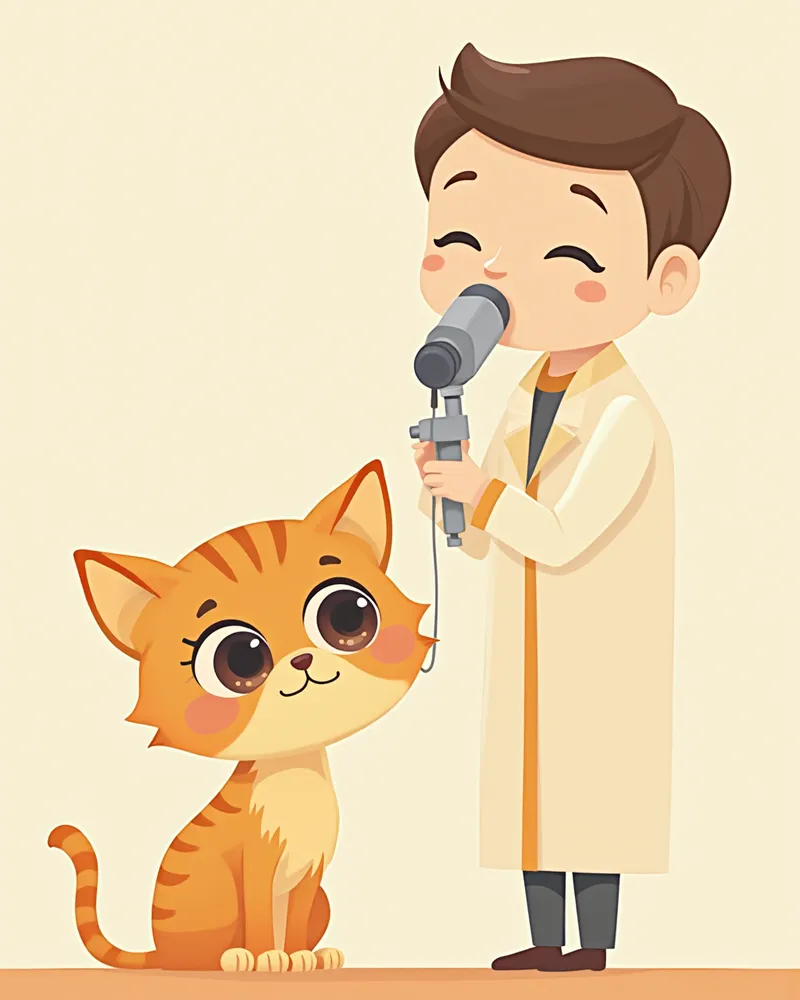
PRA screening consists of three main components. First, a fundus examination involves administering eye drops to dilate the pupils, allowing direct visualization of the inner retina. Second, an electroretinogram (ERG) measures the electrical signals generated by the retina in response to light stimulation. Third, a genetic test is performed by collecting a sample from the oral mucosa using a swab. All three tests must be conducted together to accurately assess both the current condition and future risk.
A veterinary ophthalmologist examining an Abyssinian cat's eyes

Overview of Test Types and Their Characteristics

ItemFundus examinationElectroretinography (ERG)Genetic testing
What is checkedPresence of retinal atrophyPhotoreceptor functionCarrier of defective gene
Recommended timingAnnually from 1 year of ageWhen symptoms are suspectedOnce right after adoption
Anesthesia requiredNot requiredRequired (mild)Not required
Expected cost rangeMediumHighLow

Costs vary by clinic and region, so please inquire in advance.

Management Points for Owners After Diagnosis

Unfortunately, there is currently no treatment that can reverse PRA. While products containing antioxidants are sometimes recommended to help slow the progression, they cannot prevent blindness itself. Therefore, the most important step is to stabilize your pet’s environment while they still have some vision. Keep furniture in the same place, lower the steps on cat trees, and place mats on slippery floors. It also helps to call your pet’s name to let them know where you are and to keep a soft, indirect light on at night. Antioxidant supplements may be considered as a supportive measure after consulting with your veterinarian, but please remember that they are only intended to potentially slow progression and are not a guaranteed treatment.

Must-Check Information for Rehoming or Breeding Plans

If you're planning to get an Abyssinian kitten, be sure to check the PRA genetic test results (Clear/Carrier/Affected) of both parent cats. Only if both parents are Clear will the risk of the kitten developing the disease be virtually eliminated. If you're considering breeding, avoid mating two Carrier cats. Responsible catteries will transparently share their test results.

Reviewed by a veterinarian

Dr. Tony — Punnawat Phongkittirak

Dr. Tony — Punnawat Phongkittirak

Veterinarian

A veterinarian who majored in veterinary medicine at Khon Kaen University, Thailand, and completed the IVSA program at North Carolina State University in the United States. Drawing on clinical experience at animal hospitals, he works in the pet healthcare field and is dedicated to building a digital care environment that connects pet parents with veterinarians.

Frequently Asked Questions

At what age should Abyssinian cats begin PRA screening?
A single genetic test is sufficient, ideally performed shortly after adoption or around six months of age. Fundus examinations should be conducted annually starting at one year old. Regular check-ups are the most reliable way to detect issues early, even in the absence of symptoms.
Can PRA spread to the other eye?
PRA is not an infectious disease but a hereditary degenerative condition, so it is not contagious. However, it typically progresses in both eyes simultaneously due to genetic factors.
Does vision loss in just one eye mean PRA?
PRA typically progresses symmetrically in both eyes. If vision is suddenly lost in only one eye, other causes such as trauma, glaucoma, or hypertensive retinal detachment should be considered first.
Can an Abyssinian cat that has lost its sight still live a happy life?
Cats have highly developed senses of smell, hearing, and whisker touch, so they can adapt well to familiar environments even if they lose their vision. Keeping furniture in fixed positions and minimizing hazardous height differences will allow them to navigate daily life with little difficulty.
What should I do if the genetic test result shows “Carrier”?
Carriers do not develop the disease themselves. However, they can pass the defective gene to their kittens, so if you plan to breed, the other cat must be clear.

Share

Related Guides

References

[1] Menotti-Raymond M. et al., Mutation discovered in a feline model of human congenital retinal blinding disease, Investigative Ophthalmology & Visual Science, 2010

[2] Narfström K., Hereditary progressive retinal atrophy in the Abyssinian cat, Journal of Heredity, 1983

[3] Little S., The Cat: Clinical Medicine and Management, 2nd Edition, Elsevier, 2024

This information is based on veterinary literature and does not replace diagnosis or treatment. Please consult a veterinarian for specific health concerns.

Metapet Co., Ltd. | CEO: Park Sung-yong | Business Reg. No. 417-88-02562 | Seoul, South Korea | Customer Center

Abyssinian PRA: Early Screening & Genetic Management Guide | Meongsiljang