
Like
Share
멍실장
주간 양치·치아 케어 루틴

Weekly Brushing & Dental Care Routine

Oral HealthPreventionMeongsiljang Veterinary Advisory Board

We’ve outlined a step-by-step dental care routine for pet owners who find daily brushing difficult, focusing on a 2-3 times per week schedule. We’ll guide you through the proper use of toothbrushes, toothpaste, dental chews, and oral sprays, along with breed-specific precautions.

What is Weekly Brushing? Why is a 'Weekly Routine' Necessary?

A pet owner organizing daily dental care supplies, with a dog and a cat sitting nearby.
Weekly brushing is an oral care routine for pet owners who find daily brushing challenging, allowing them to maintain their pet’s teeth and gums consistently two to three times a week. While daily care is ideal, a realistic routine of two to three times a week still makes a significant difference. The key is to remove plaque before it hardens into tartar. Plaque adheres to the tooth surface and gradually calcifies into tartar over time; once hardened, it cannot be removed at home and requires professional dental scaling at a veterinary clinic. Therefore, if daily brushing isn’t feasible, the most important thing is to brush as often and as consistently as possible. Keep in mind that approximately 80% of dogs and 70% of cats are known to have some degree of periodontal disease by around three years of age, and recent studies indicate that over 90% of dogs show signs of periodontal disease.

Essential Checks Before Starting Weekly Brushing

If plaque has already built up thickly or if the gums are red, swollen, and bleeding, professional dental scaling at a veterinary clinic should be done before starting home brushing. Brushing inflamed gums can cause pain, leading to lifelong resistance to tooth brushing. If there is severe bad breath, chewing on only one side, or frequent scratching around the mouth, please consult a veterinarian before beginning a weekly dental care routine.

Method 1: Toothbrush & Toothpaste Brushing (Most Effective)

For a long time, brushing has been considered the most effective standard method for preventing periodontal disease. Prepare a pet-specific toothpaste (human toothpaste is not recommended for pets because it is not formulated to be swallowed—use only products designed for animals) along with a soft pet toothbrush or a finger brush. Brushing for 1–2 minutes, two to three times a week, is sufficient. - Brush angle: Hold the brush at a 45-degree angle to the gumline. - Motion: Use small, gentle circular motions. - Starting point: Begin with the outer surfaces of the molars (saliva helps clean the inner surfaces). - Pacing: Start with just a few front teeth and gradually expand the area covered. - Acclimation period: Introduce the routine gradually over 2–4 weeks.
Brushing your dog’s teeth at a 45-degree angle

Method 2: Dental Chews (Utilizing Chewing Force)

It’s safest to choose products certified by the Veterinary Oral Health Council (VOHC). The VOHC seal indicates that a product has been evaluated and shown to help control plaque and tartar. Offering these treats three to five times a week can serve as a helpful supplement to brushing. - Dogs: Select the size appropriate for your dog’s weight (treats that are too small pose a choking hazard if swallowed whole). - Cats: Kibble-style and cheese-style dental treats are suitable options. - Caution: Avoid excessively hard treats such as rawhide, beef bones, or pig’s trotters, as they can damage teeth. - Limitations: Chews alone cannot reach the back molars, so they should only be used as a supplement to brushing.

Method 3: Oral Sprays, Gels, & Water Additives
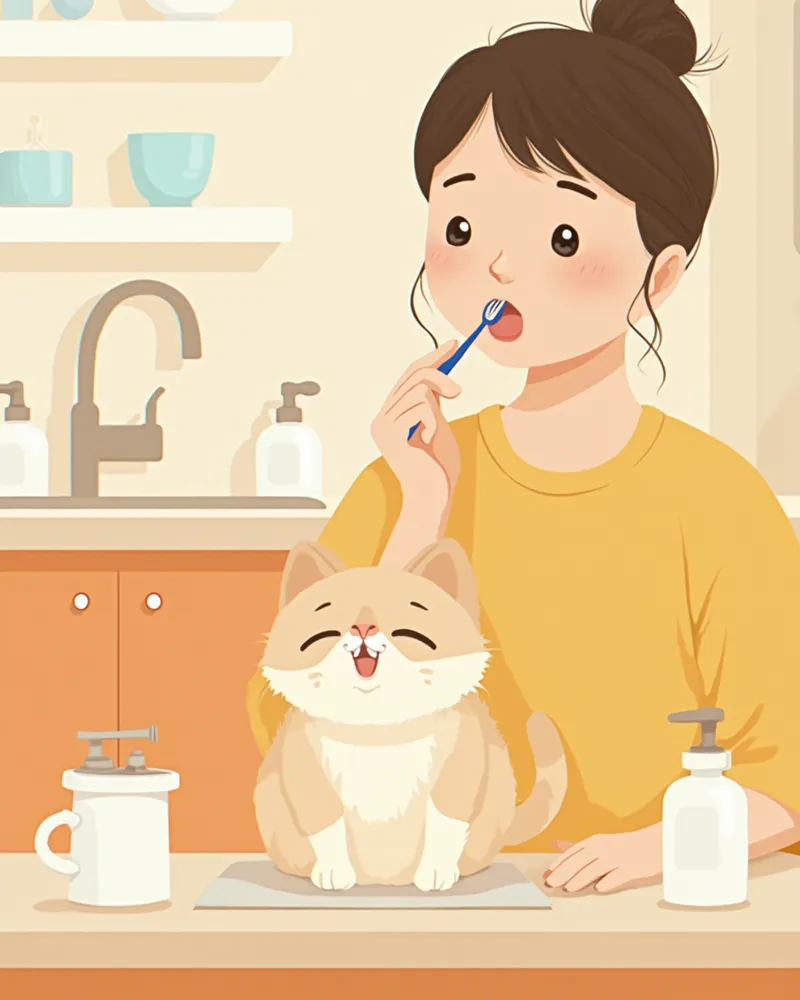
These products can serve as helpful aids for pets that strongly resist brushing. The active ingredient, chlorhexidine, has been clinically proven to inhibit plaque formation. However, its effectiveness is maximized when used in conjunction with regular toothbrushing, rather than as a standalone treatment. - Spray: Spray directly onto the gums after brushing or following meals. - Gel: Apply directly to the gums or onto a toothbrush for use. - Water Additive: Dilute in drinking water (note that cats often reject this method). - Limitations: Since these products have limited ability to physically remove plaque, using them alone is not recommended.
A caregiver's hand applying dental gel to a cat's gums

Comparison of Effectiveness by Dental Care Method

ItemToothbrush & ToothpasteDental ChewsOral Spray & Gel
Plaque Removal EffectVery highModerateLow
Tartar Prevention EffectVery highModerate to highModerate
Recommended Frequency2–3 times a week or more3–5 times a weekDaily use possible
Difficulty for BeginnersHighLowVery low
Usable AloneTrueFalseFalse
VOHC-Certified Product RecommendedTrueTrueTrue

Dental chews and sprays are most effective when used as tools that supplement brushing.

Creating a Practical Weekly Routine (Day-by-Day Checklist)

The key to success is keeping sessions short, frequent, and positive. When you stick to a consistent schedule, your pet will come to expect and accept the routine. - Monday, Wednesday, Friday evenings: Brush teeth for 1–2 minutes (recommended 1 hour after meals) - Tuesday, Thursday, Saturday: VOHC-approved dental chews or dental treats - Daily: Oral spray or water additive (optional) - Reward after brushing: Provide praise or a treat immediately, within 10 seconds - Weekly check: Inspect gum color (pink is normal), breath odor, and any bleeding - Annually: Professional dental cleaning and oral examination at the veterinary clinic
A daily teeth-brushing routine chart alongside dental care tools

Special Precautions by Breed & Age

Brachycephalic breeds (such as Pugs, Shih Tzus, Pekingese, and Persians) have narrow jaws that lead to crowded teeth, making them more prone to plaque buildup. Crowded or misaligned teeth create rough surfaces where plaque easily accumulates, so increasing your daily oral care routine to three or four times a week can be helpful. Small-breed dogs (such as Pomeranians, Yorkshire Terriers, and Maltese) also often have tightly spaced teeth, so it’s best to start a consistent oral care routine from an early age. For senior dogs and cats aged seven years or older, periodontal disease may already be present, so please have a professional oral examination performed before starting any home care routine.

Reviewed by a veterinarian

Dr. Tony — Punnawat Phongkittirak

Dr. Tony — Punnawat Phongkittirak

Veterinarian

A veterinarian who majored in veterinary medicine at Khon Kaen University, Thailand, and completed the IVSA program at North Carolina State University in the United States. Drawing on clinical experience at animal hospitals, he works in the pet healthcare field and is dedicated to building a digital care environment that connects pet parents with veterinarians.

Frequently Asked Questions

While daily brushing is the gold standard, is brushing two to three times a week sufficient?
While daily care is ideal, a realistic and sustainable routine of two to three times a week is actually more effective than sporadic daily brushing. Plaque hardens into tartar over time, and once it calcifies, it becomes difficult to remove at home. Therefore, the most important guideline is to maintain regular care as frequently as possible.
Can cats also have their teeth brushed?
Yes, it is possible. However, it takes two to three times longer for cats to adjust than for dogs. Please introduce the process gradually over two to four weeks, starting with touching around the mouth, then rubbing the gums with your finger, followed by gauze, a finger toothbrush, and finally a pet toothbrush. If you rush the process, your cat may develop a lifelong aversion to it.
Is it okay to use a little bit of human toothpaste?
We don't recommend it. Human toothpaste is not designed to be swallowed, so it may not be suitable for pets. Please use only toothpaste specifically formulated for pets.
How should I start if my pet strongly dislikes brushing their teeth?
Start with a combination of dental chews, oral gel, and water additives. At the same time, practice touching around your pet's mouth for 10 seconds daily. This will help transition to toothbrushing within 1-2 months. The key to success is always providing positive reinforcement.
If tartar has already built up, can it be removed by brushing once a week?
Existing tartar cannot be removed at home. The correct approach is to first have the tartar professionally scaled off at a veterinary clinic, and then begin weekly brushing to prevent recurrence.

Share

Related Guides

References

[1] Rawlings, J.M., Gorrel, C., Markwell, P.J. (1998). Effect on canine oral health of adding chlorhexidine to a dental hygiene chew. Journal of Veterinary Dentistry 15(3): 129-134

[2] Applied Veterinary Clinical Nutrition, 2nd Edition — Dental Health and Nutrition Chapter

[3] American Veterinary Dental College (AVDC), Home Oral Hygiene Guidelines for Companion Animals, 2019

[4] Veterinary Oral Health Council (VOHC), Accepted Products for Plaque and Calculus Control

This information is based on veterinary literature and does not replace diagnosis or treatment. Please consult a veterinarian for specific health concerns.

Metapet Co., Ltd. | CEO: Park Sung-yong | Business Reg. No. 417-88-02562 | Seoul, South Korea | Customer Center

Weekly Brushing & Dental Care Routine for Dogs & Cats | Meongsiljang